Bonus Episode II: The Gay and The Lord
As I Wish – Side Story (15 Min Read) By AD 5814, this old religion becomes the supreme faith of all humankind.

Continuing from the previous episode: Bonus Episode I: The Gay Lord
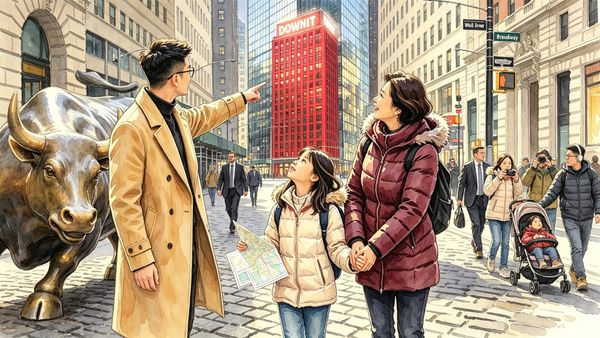
That summer noon, Will stepped out of Penn Station, dragging a huge suitcase behind him. Along with the blazing heat came waves of strangers—men and women, tall and short, blue eyes, brown eyes, blonde hair, black hair. Every race. Every age. Every language.
Once again, he arrived in a new place.
Once again, everything reset to zero.
Once again, he had to start over.
Here, no one knew his past. His fluent English used to earn widespread admiration. Now it was just the bare minimum for daily life. His college degrees used to make people marvel. Now nobody cared whether that foreign university was awesome or obscure. And even if it was top-tier, so what? Stand on any street corner in Manhattan and ask. Harvard, Stanford, and MIT graduates are a dime a dozen, New Yorkers would say. In this city, nuclear physicists from Russia, violin virtuosos from Italy, beauty queens from Venezuela—all faded into the crowd, working ordinary jobs and collecting paychecks barely enough to scrape by.
The reward, after giving up every halo of his former life, was that he could finally live as a “normal.” Study as normal. Work as normal. Date as normal. No more hiding. No more pretending. No more explaining.
As a gay man, an immigrant, and an adult, his new life was no longer worth anyone’s curiosity or scrutiny. He maintained a purely transactional relationship with the outside world. Here, as long as the bills were paid, nobody gave a damn how he lived his life. He didn’t have to attach himself to anybody. He didn’t have to please anybody. Nor did he bother paying attention to anybody—except hot white men between the ages of twenty-five and thirty-five.
What he cherished most in his new life was the state of mind of American gays. In contrast to their Chinese peers, who were soaked in fear, anxiety, shame, and self-loathing, the American gay community seemed straightforward, confident, dignified, and unapologetic. To them, living as normal came so naturally, as though they had never been given a hard time, as though being gay had always been ordinary.
In truth, it was anything but ordinary. Will had read too many American books, watched too many American films, and followed too much American news. He understood that none of it came for free. An enormous price had been paid for this “ordinary life.”
The United States as a whole was nowhere near as progressive as he had once imagined. New Yorkers and Alabama farmers were practically two different species—they had almost reached reproductive isolation. Washington, D.C.’s elites returned from neighboring West Virginia feeling the need to disinfect themselves from head to toe. Every hostility Will experienced in China—discrimination, rejection, humiliation, and stigmatization—used to be common in America too. The only difference was that America had gone through the baptism of social reflection and change decades earlier.
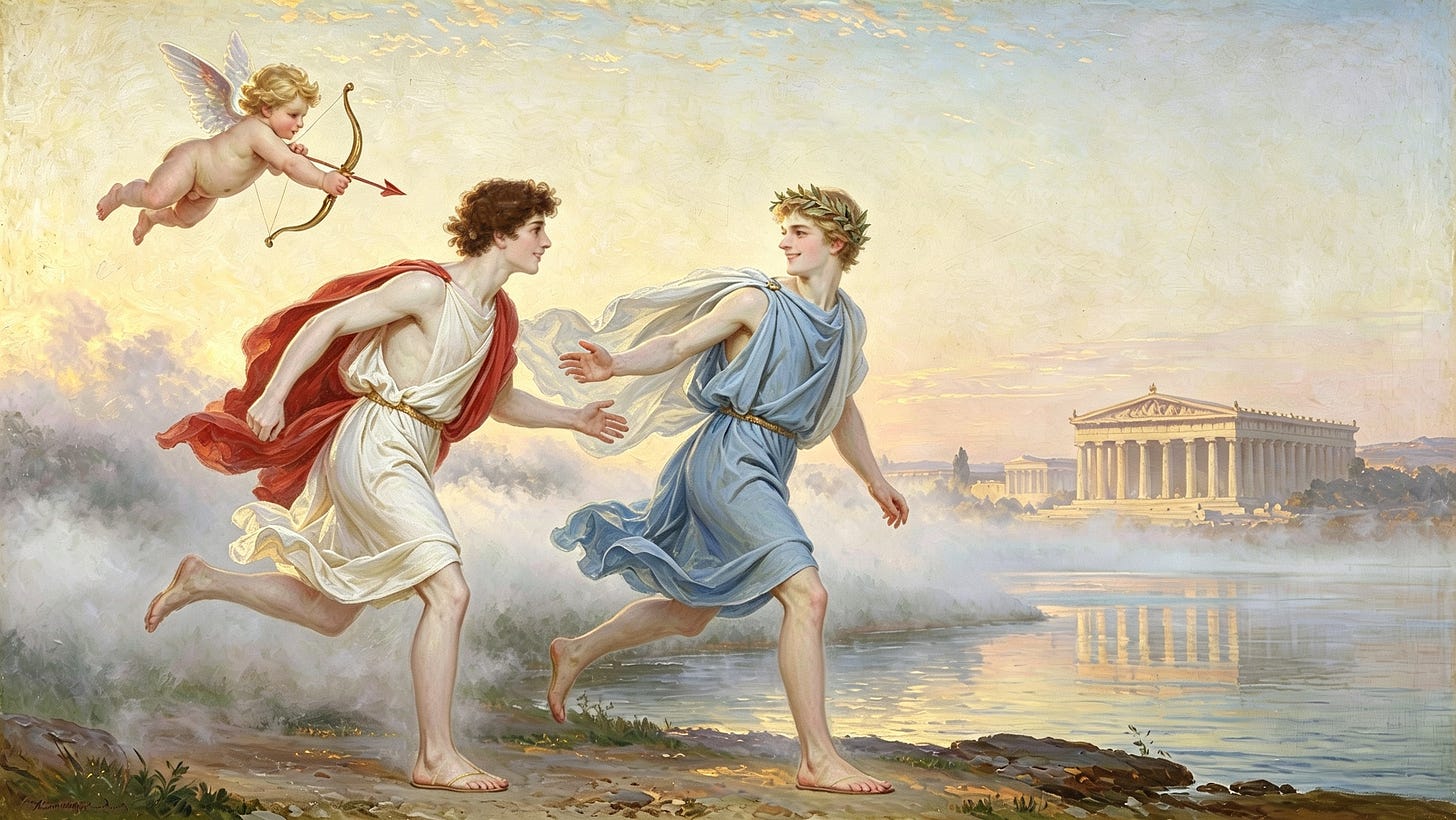
That baptism was born of years of victories and defeats, sweat, tears, and blood. An entire society debated the gay issue openly, inside and out, until one day in 2015, when the highest authority in the country announced its conclusion, its final decision: From now on, we treat gay people as normal citizens.
Before gay people, American society had gone through similar baptisms for many other groups. The same echo rang throughout history:
From now on, we treat slaves as normal citizens.
From now on, we treat women as normal citizens.
From now on, we treat Chinese immigrants as normal citizens.
……
Gay people are the canaries in the coal mine of civilization. If they cannot live well in a place, then neither can the majority.
Where gay people are not respected, women are not respected either. Women become the second sex. They may be required to cover themselves, please men at all times, and exist as little more than childbearing wombs. They may be denied education, property, and a political voice.
Where gay people are not treated with kindness, children are not treated with kindness either. They are neither valued nor cared for. They may be raised in hatred, exploited by adults, or even turned into weapons to “sacrifice.”
Where gay people are invisible, people with disabilities are invisible too. Physical limitations and imperfections are met with contempt. No wheelchair ramps beside staircases. No tactile paving along sidewalks. No accessible restrooms in public buildings.
And that’s not all.
Where gay people are not protected, powerless animals are not protected either. They are slaughtered brutally, abused cruelly, and killed for amusement. Dogs and cats—humanity’s furry babies—can be abandoned like garbage. Yet their owners and abusers face no consequences whatsoever, because in such countries, animal protection laws simply do not exist.
Where gay people cannot live as normal:
Democracy does not exist. The slogan of that place might as well be: Long Live the Dictator! The country’s leader is absolutely plotting to pass the throne to his son—or his daughter, if no son is available—or his son-in-law, if she is married.
Freedom of speech does not exist. Anyone can be silenced, imprisoned, or killed for posting something online or simply speaking their mind.
In those places, the law of the jungle still rules. Human vulnerability is not tolerated. Society is still built upon conflict, struggle, and scarcity.
In this era, when the internet connects everybody in real time, satellites patrol above our heads nonstop, and flights can carry people to any corner of this planet within a day, humanity has every reason to move beyond its primitive instincts—ignorance, cruelty, and impulsiveness—and treat all living things with kindness.
Gay rights are never just about gay people. They are one thread in the great tide of modern civilization.
Will remembered a quote from his history book: The tide rolls onward—vast and unstoppable.
For decades, he had watched this tide sweep from country to country, society to society, and mind to mind, following a familiar path. It always began in Northern or Western Europe—the Netherlands, Denmark, or Finland—where social experiments showed the world: See? It’s okay. Then the tide swept across the Commonwealth countries—Canada, Britain, and Australia—before reaching Southern Europe and, afterward, the United States.
Once America embraced the tide, its momentum became irresistible. Social change became the norm, the default, the new normal for humanity. From there, the tide swept through the Caribbean, South America, and Eastern Europe with ease, crushing everything in its path.
Of all remaining countries, the one that concerned Will most was, of course, China. Chinese people of recent centuries were known for being conservative, unlike their extraordinary ancestors. Would the tide of civilization ever reach China? Will often wondered. And when it did, would it take the same path America had?
Finally, on the eastern side of the Taiwan Strait, a group of Chinese people stood up. They fought their way through the same process America had: back and forth, victory and defeat, struggle and resistance, sweat, tears, blood, and death. It felt almost unreal—they spoke the same language, yet this was not the China he grew up in. Politically, it had nothing to do with him, yet he was nonetheless swept up in the wave, through his computer screen.
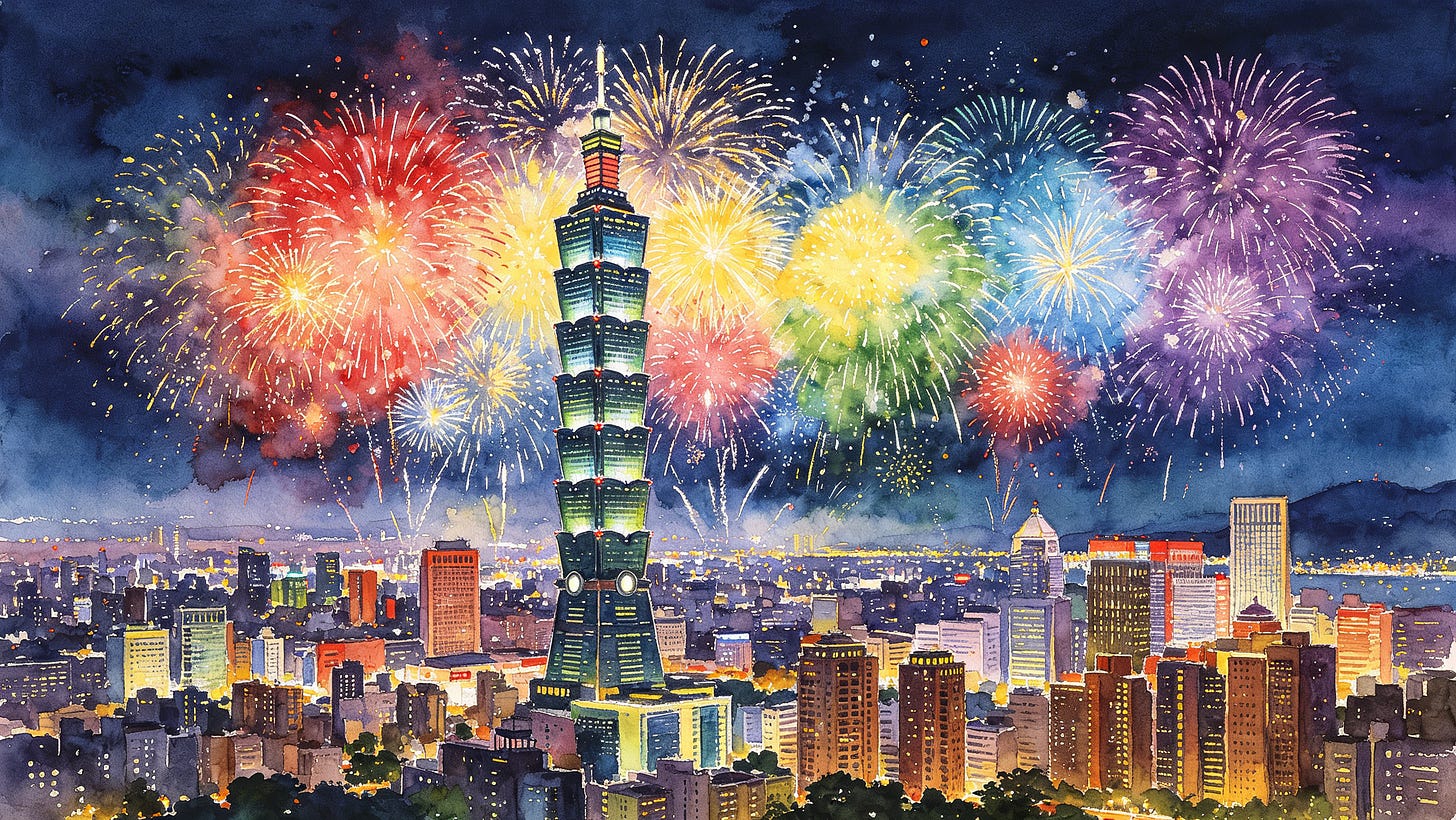
At last, this group of people proved to the world that they had not disgraced the millennia-old Chinese civilization. On a day in 2019, their president announced, in Mandarin, his mother tongue, “From now on, we treat gay people as normal citizens.”
All night long, fireworks set Taipei’s sky ablaze. The whole island blossomed like the radiant peonies of the High Tang—confident, open, and embracing all under Heaven.
So what about the other side of the Strait, where people claimed the same language and the same blood?
Change is never about right or wrong, but about power. He knew that land and its people all too well. The tide of protest, debate, and reconciliation would not arrive anytime soon. As far as he could see, there was only one path to real change: wait for that generation to die.
When the old returned to dust, the new would live by a different set of rules.
There was no need to feel discouraged. For thousands of years, that had always been how the land settled its unresolved debts: the perpetrators died, the victims died—no apology, no reflection, no lessons learned—in the end, time wiped everything clean.
Waiting was the only choice.
The void of time contained every possibility.
Speaking of time, Will had a secret.
Over the years as a junior clerk in the central government, he cooked up countless reports. That was his job. Most of the time, there was no data, no research, no resources, and no one to ask. He could only piece together whatever he found online, like a student cramming for an essay. To his surprise, some of those casual reports were soon distributed from Beijing down through the provinces, cities, counties, districts, and villages as official documents. His scribbles were studied downstream with the reverence of sacred scripture. They became “Orders from the Highest Power,” amplified layer upon layer until they hardened into absurd yet unquestionable government directives.
Maybe that was simply human nature, no different from hairless apes.
So, on the day he resigned—knowing he would probably never return to this place in his lifetime—he decided to play a prank.
In the middle of the government compound stood a towering stone stele. It had been there for six hundred years, proclaiming to Heaven and Earth the eternal glory of a Ming emperor. While no one was watching, he firmly wedged an inscribed titanium plate into a crevice beneath the massive stone base. Then he sealed the gap with concrete, entombing the plate as securely as the mausoleum guarded by the Terracotta Warriors.
Then he turned in his badge and walked toward a new life without looking back.
Maybe decades later, maybe centuries later, the stele would collapse—brought down by war, weather, or accident. The titanium plate would be discovered. People might regard it as nothing more than an amusing artifact. It would end up in a museum or be forgotten in some warehouse, alongside the fallen monument.
Centuries would pass. Generations would be born and die. Museums become ruins. Warehouses turn to dust. The plate would be buried once more.
Two thousand years later, every trace of the twenty-first century had vanished. Even granite had weathered into sand. The plate, however, would inevitably be unearthed again.
Some people might publish meticulously researched papers, demonstrating that the Ming emperor was actually half-human, half-alien, who spoke fluent English.
Some people might passionately promote a “retro lifestyle” based on the plate’s inscription. They claim that by practicing the wisdom of the Ancients, their bodies grow healthier and their souls happier.
Some people—perhaps for fun, perhaps for tax exemption, or simply for they are lunatics—declare it a divine revelation. A new religion would thus be born.
Another thousand years would pass.
By AD 5814, after countless miracles, pilgrimages, inquisitions, crusades, and massacres, with the full weight of civilization behind it—painting, music, literature, sculpture, philosophy, and science… this old religion would finally become the sole, unquestionable, supreme faith of all humankind. Everyone would memorize, recite, and devoutly obey the divine revelations engraved on this titanium plate from the twenty-first century.
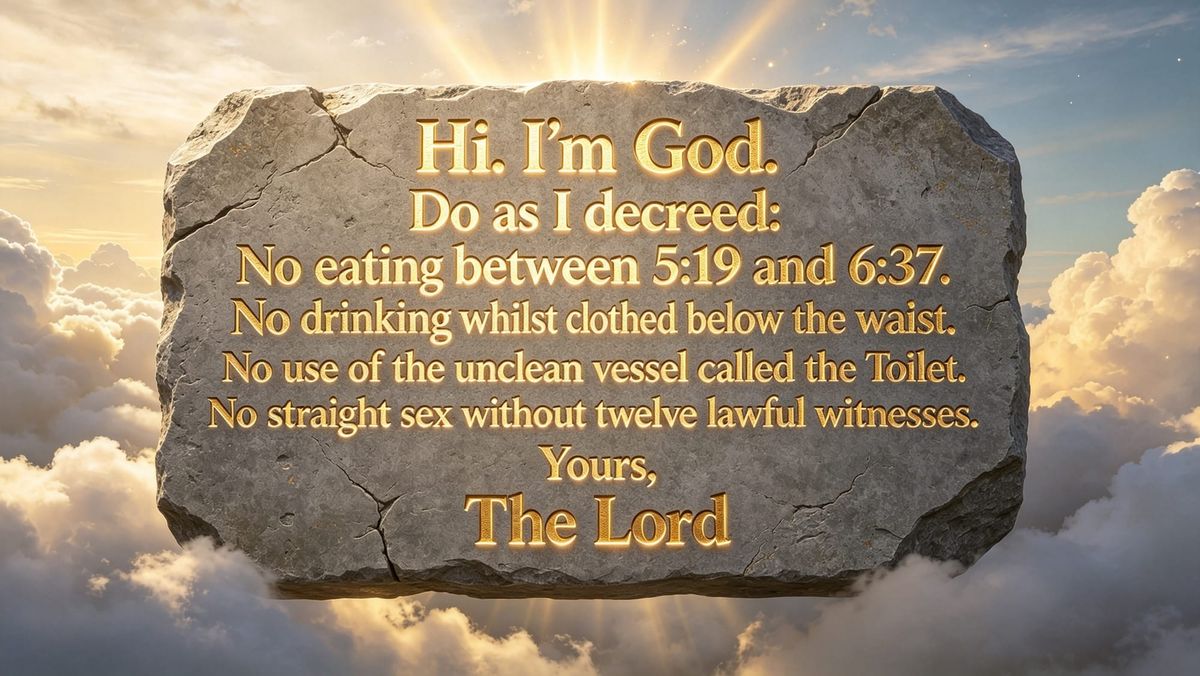
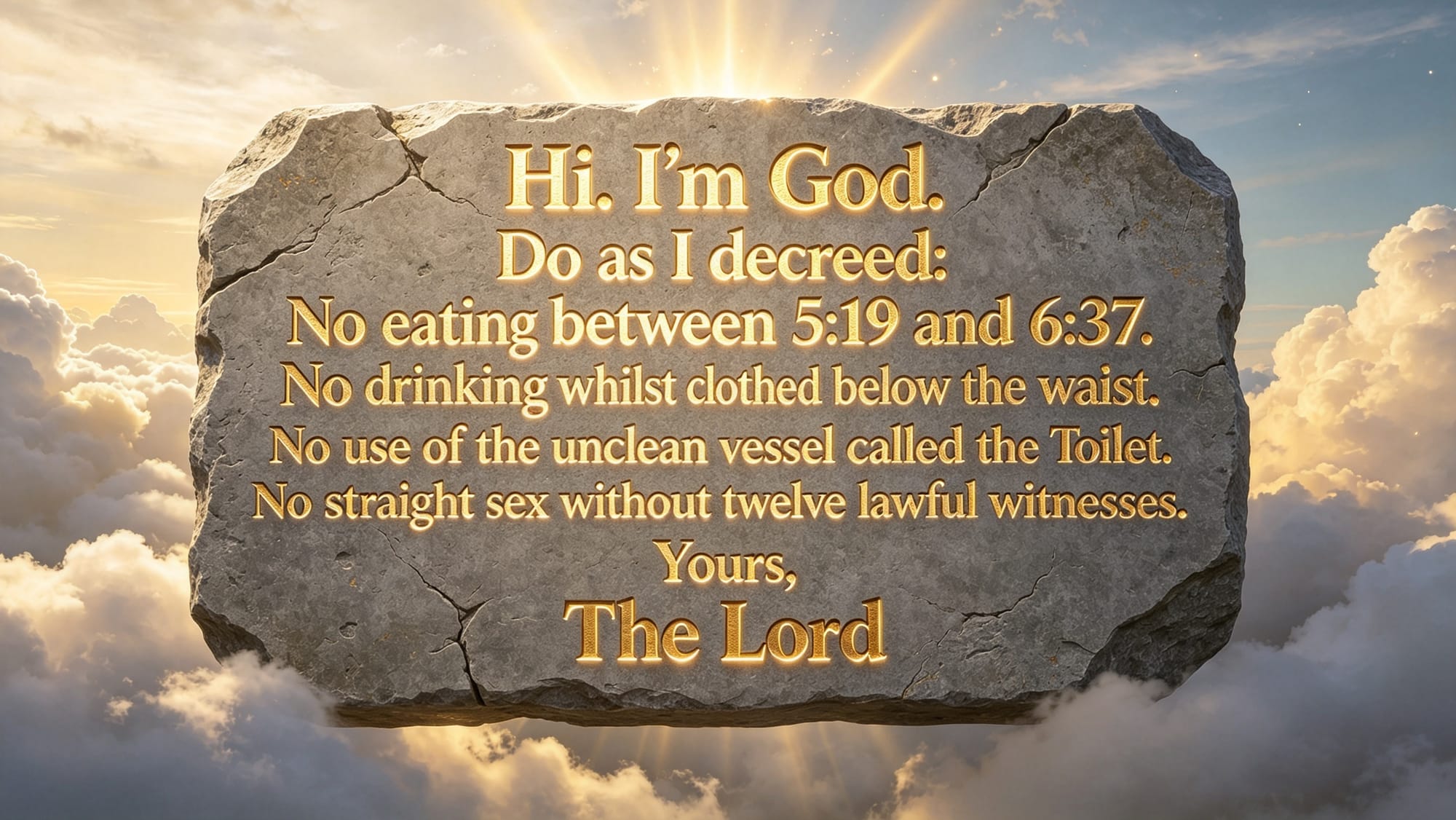
The sacred plate read:
Hi. I’m God.
Do as I decreed:
No eating between 5:19 and 6:37.
No drinking whilst clothed below the waist.
No use of the unclean vessel called the Toilet.
No heterosexual intercourse without twelve lawful witnesses.
Whoever breaks these commandments commits an unforgivable sin and will suffer eternal damnation.
Yours,
The Lord
End of Story
Albert Aspen’s work is published simultaneously on this site and on his Substack page. If you prefer reading on Substack, please visit: Who is Albert Aspen?
Check out Albert Aspen’s Audiobooks on Spotify: Albert Aspen Audiobooks.