Ep 13: The World After Growing Up
As I Wish – Chapter Bull (14 Min Read) Thirty Years Later, Nothing Remains the Same

Disclaimer: This is a work of fiction. Any resemblance to reality is, of course, coincidental.
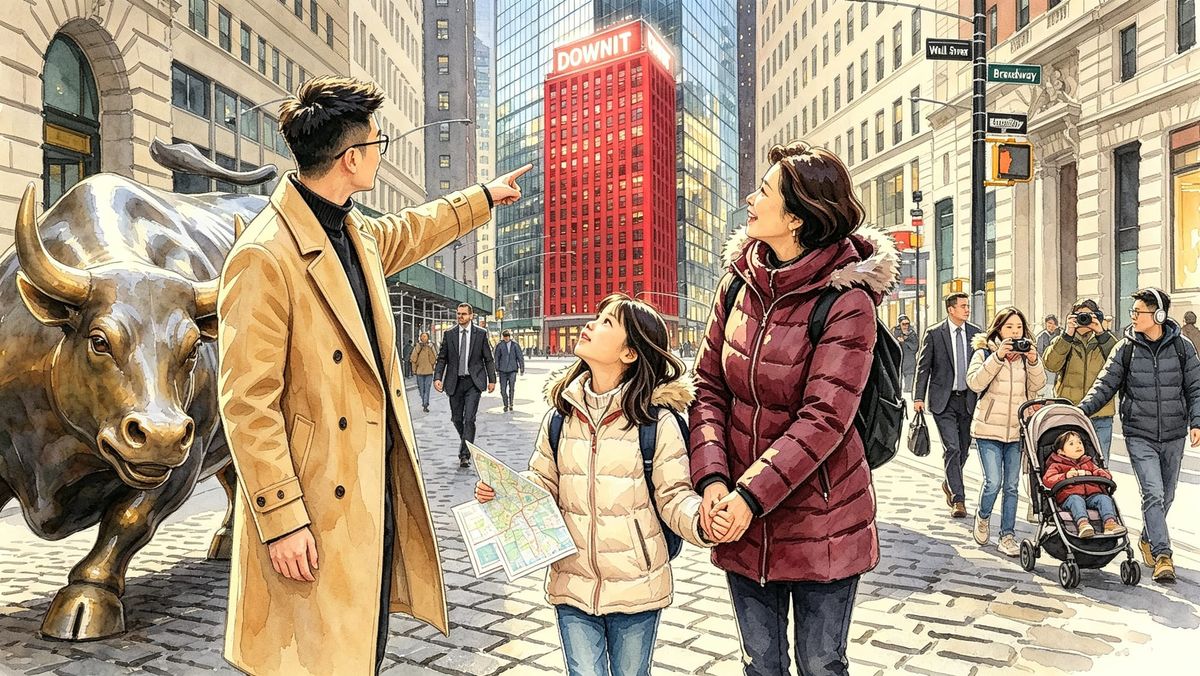
“Thank you, handsome!” the older woman said in Mandarin as she extended her left hand to take back the phone. “Where are you from?” Of course, by “where,” she meant where in China.
“River North Province,” Will replied. “How about you?”
Just then, a hurried passerby cut between them, knocking the device to the ground before continuing on without so much as a glance back.
“Very classy. Asshole! You late for your own funeral?” Will shouted in English at the jerk disappearing into the distance. Then he turned back and asked in Mandarin, “Is it okay?”
The woman bent down, picked the sleek slab up, and checked it over. “Thank Buddha! It’s fine. Phones today are smarter, but far too fragile. Those Motorola bricks back in the 1990s could dent the floor if you dropped one.” Her face darkened again. “Look at people like this. Americans have lost their manners.”
“Well, this is New York,” Will explained. “That person could’ve come from anywhere in the world.”
“You’re right.” She nodded. “That’s why people say, ‘New York is New York. America is America.’” Then, smiling again, she asked, “Do you work nearby, handsome?”
“Yes,” Will replied, shoving his hands into his pockets against the cold.
“Wow, so you’re one of those Wall Street elites!” she exclaimed in Mandarin to her daughter. “How Niu Bee!”
Niu Bee. Perhaps Quentin Tarantino’s favorite Chinese phrase. Translated literally, it meant “cow cunt,” though its actual meaning could not have been further from that: something closer to “fucking awesome.”
Will felt slightly embarrassed. It had been many years since he last heard such a vulgar yet sincere compliment.
“Did you also study here in the United States, handsome?” she probed further.
“Yes. The one uptown,” Will answered, deliberately keeping his reply vague.
The woman immediately gave him a thumbs-up and burst into excited admiration. “Then it must be Columbia University—Ivy League!” She turned to her daughter. “Learn English well, study at an American university, come to New York, get a stable job in one of those tall office buildings, and earn big U.S. dollars. Just like this uncl—” Catching the stiffness in Will’s expression, she quickly corrected herself. “—big brother!”
The woman’s affectionate gushing suddenly reminded Will of his mother. Back when he was a child, in that shabby place he called home, in a life soaked in scarcity, his mother had spoken those exact same words in that exact same tone: Learn English well. Study at an American university. Go to New York. Then get a stable job in one of those bright office towers and earn big U.S. dollars. All at once, the years in between seemed to collapse. He now stood at the far reach of his childhood wish—having crossed swamps, climbed mountains, and sailed across oceans, all to become an ordinary office worker in New York.
“Thank you. What about you? Visiting as tourists?” Will asked.
“Yes. This is my second time. It’s very difficult to get a visa nowadays, thanks to this U.S. president,” the woman complained.
“Oh? When did you come last time?”
“1996. Thirty years ago.” She shook her head. “This time, everything in New York feels obsolete and rusty. The subways, the airports, the potholes, the cityscape…crazy people everywhere…” She paused before adding, almost matter-of-factly: “Compared to this, Shanghai is far more advanced now.”
“Really?” Will glanced around, realizing he had lived in New York too long to find anything strange anymore.
“Haven’t you gone back to see for yourself?” she asked, equally astonished.
“No. I haven’t been back to China in… years.” Will paused, calculating silently. How many years had it been since he first came to the United States? Two years for his master’s degree, then one year of OPT, followed by three years on an H-1B visa. Now he was already in the second year of his H-1B extension, praying his company might someday show mercy and sponsor his green card…
“By the way, handsome, do you know where we can buy some souvenirs?” the woman asked, smoothly moving on to the next topic.
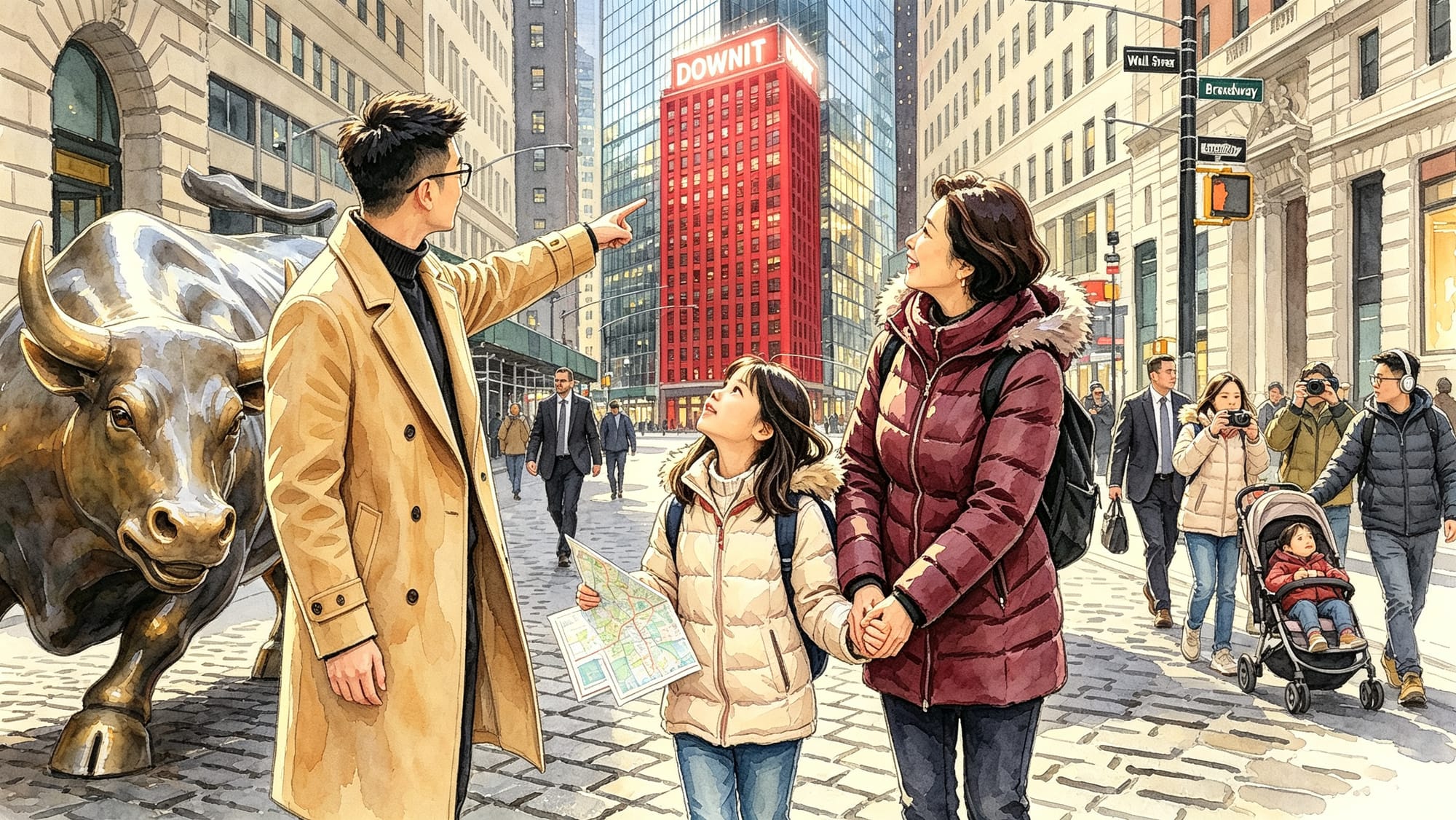
“I think there’s a gift shop right over there.” Will pointed toward the street corner.
“Oh, no! They’re all ‘Made in China.’ We want to buy products actually made in America. If we carry these all the way back home and our relatives flip them over to see a ‘Yiwu, Zhejiang’ stamp, they’ll laugh us to death.” She curled her lip, mimicking their smug, mocking expressions. “‘Oh wow, so you flew halfway across the world just to buy things made in the next town over?’” Then she looked back at Will, suddenly sincere again. “Is there somewhere else we could try?”
Will thought for a moment, then pointed toward a skyscraper farther south. “See that building? The one with D-O-W-N-I-T on the roof. That’s the famous president’s building. Inside, he even set up a gift shop dedicated entirely to himself.” Will paused slightly before adding: “Those products are probably made in America… I suppose.”
“They are made in China too,” her daughter answered immediately.
“Oh, yes, we just went there,” the woman said. “Those giant-face mugs, those red slogan hats, even the calendars with the whole fake-smiling family—all ‘Made in China.’” She shook her head. “He rails against China every single day, yet apparently can’t manufacture even one of these little knickknacks himself.” Then she asked: “Does America still make anything anymore?”
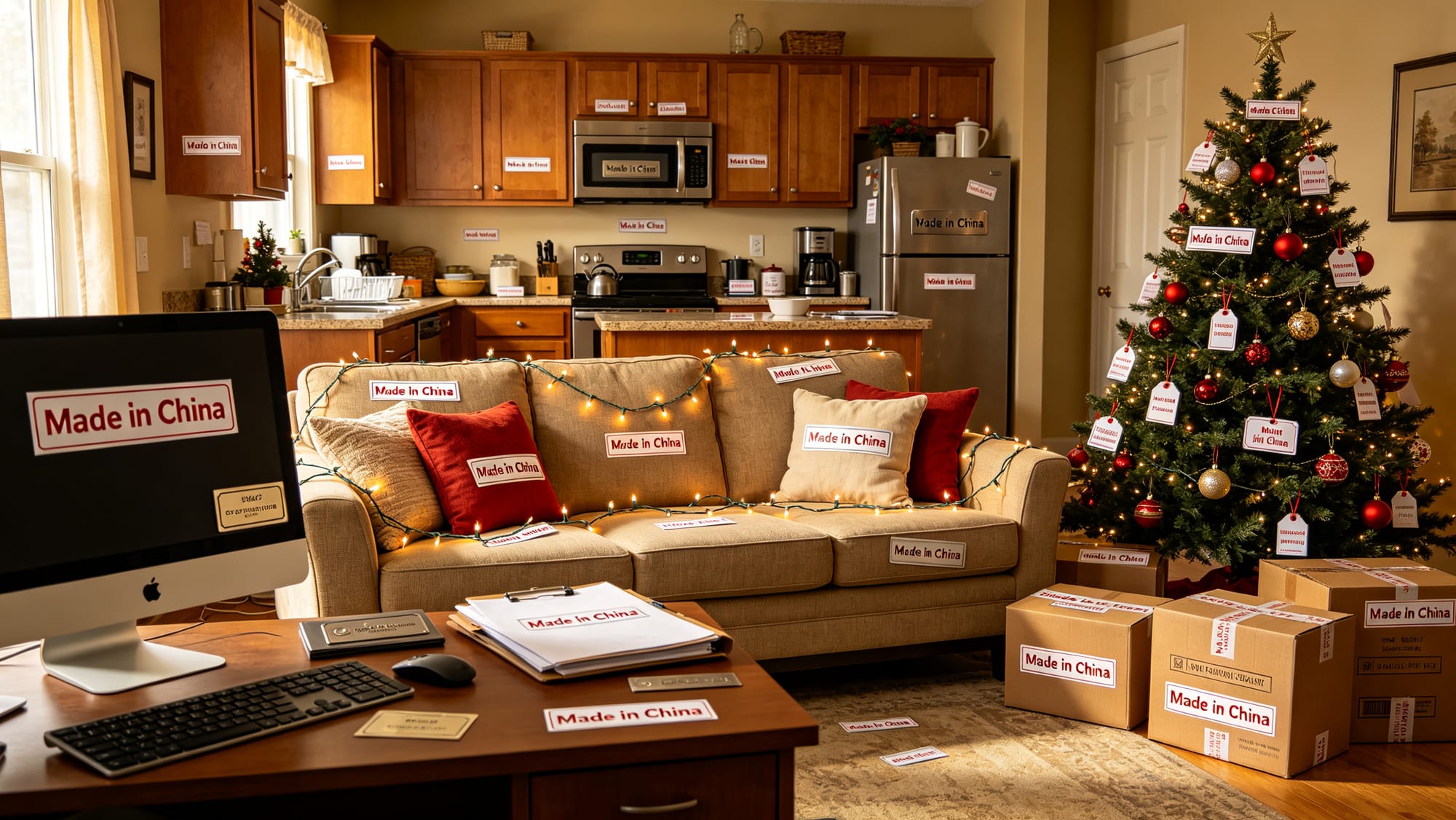
In the 2020s, the United States looked almost addicted to “Made in China.” From earplugs to loudspeakers, from treadmills to gaming chairs, from Bibles to sex toys, from condoms to baby bottles, from wedding decorations to divorce-paper folders, from Christmas lights to the trash bins used to throw them away. Computers, desks, toilets, mugs, hangers, lamps, even American flags—one way or another, openly or indirectly, almost everything seemed touched by the label: “Made in China.” Materially speaking, the People’s Republic had quietly colonized everyday American life. Which made the question difficult to avoid: What, exactly, did the United States still manufacture?
“Well, why don’t I help you find out?” Will took out his phone and spoke into the AI in English: “Hey AI, what products are still made in the USA nowadays?”
The AI immediately began listing American-made merchandise: AR-15 rifles, F-35 fighter jets, NVIDIA AI chips, SpaceX rockets…
Will rolled his eyes. “Okay, AI, be realistic,” he muttered. “Just tell me where I can buy some fuc—” He stopped himself and rephrased: “Where can I find some fun ‘Made in America’ souvenirs around Downtown Manhattan?”
He then turned the screen toward the woman. “It says to try Union Square. There’s a small market where local craftspeople sell handmade things. Ordinary Americans making things themselves.” Will paused before adding dryly: “So those should be genuinely OG ‘Made in America.’”
“You are so helpful! Thank you, handsome.” Then the woman pressed on: “Are you married?”
Will almost rolled his eyes to the sky. Older generations never seemed to understand personal boundaries. Give them an inch and they would take a mile—always asking whether you were married, whether you had children... He truly wanted to slam the words in her face: That’s none of your business.
But maintaining an elegant composure, he replied, “Not yet. I am in a relationship.”
“That’s wonderful! A handsome man like you must have girls lining up. Marry a pretty white wife and have a mixed-race baby!” the older woman giggled cheerfully.
This time, Will rolled his eyes to the highest heaven. Still, he kept his composure, pretended to check the time on his phone, then said politely: “Well, I should get back to work. Enjoy your visit. Goodbye!”
Finally, the pizza shop was only a few steps away. Yet the buzz of an incoming video call from “Chris Withers” stopped him in his tracks. A smile immediately spread across his face as he pressed “Accept.”
“Hey, babe! How are you doing?” A man with a warm smile popped onto the screen, his background blurred.
End of Episode
Albert Aspen’s work is published simultaneously on this site and on his Substack page. If you prefer reading on Substack, please visit: Who is Albert Aspen?
Check out Albert Aspen’s Audiobooks on Spotify: Albert Aspen Audiobooks.