Ep 03: Moments in the 1990s
As I Wish – Chapter Mouse (10 Min Read) The memory of the 1990s—small-town China and the influence of the USA.

Out through the school gate, Little Mouse turned left and followed a narrow eastbound alley for ten minutes. Then he turned right into another, and right again—like moving across a Go board—until South Palace’s Main Street came into view. At dusk, the street was at the height of its bustle.
On this freshly poured cement street, traffic followed one guiding principle: do as you please—within your means. No rule forbade ox carts from rolling onto the road, and the newest Toyota Crown, model 1993 and coated in canary yellow, felt no obligation to yield to pedestrians. Bicycles still dominated, weaving through every gap. There were no crosswalks, no traffic lights, and no signs to slow anybody down. A long-haul bus bound for the provincial capital rumbled down the street, its ticket seller craning her head out the window and calling at the top of her lungs, “To Stone Village! Stone Village! One more passenger, one more passenger! Just one more and we will be on our way!”
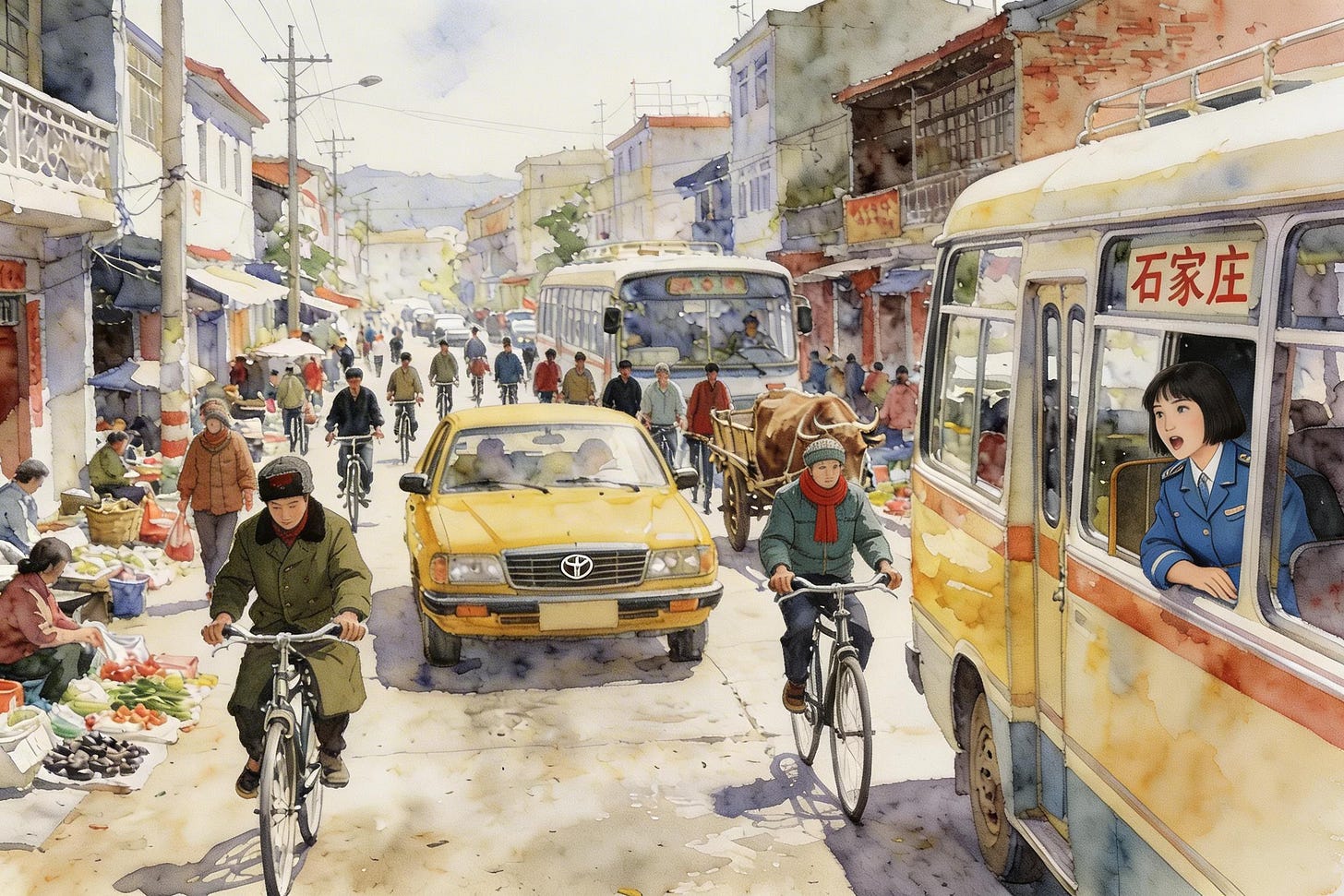
Little Mouse moved through the city’s evening symphony. Hooves struck the pavement, horns pierced the air, and shouts overlapped in restless layers. Aside from the empty pocket and the hunger in his belly, he felt nothing out of place.
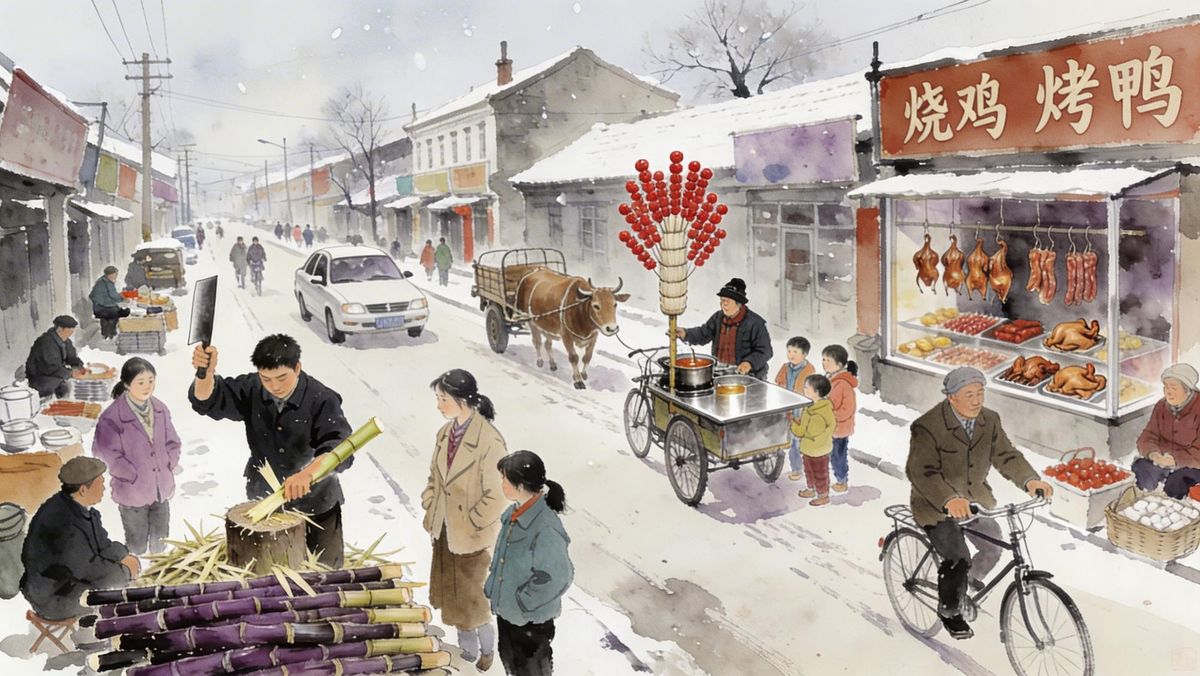
The streetlights had not come on; people getting off work drifted from stall to stall. Some vendors along the curb were selling boiled corn and roasted sweet potatoes; others were hawking to lure customers to the frozen fish laid out on the rear racks of their bicycles; still, others were plunging skewers of hawthorn, tangerines, and strawberries into a wok of jujube-red syrup bubbling over the fire. One by one, the sellers drew them out, slammed them against a cold steel counter to set the glaze, then fixed each onto tall straw-woven poles bristling with candied fruit—like auspicious trees laden with red jewels.
A middle-aged sugarcane vendor swung his machete in broad, rapid arcs, hacking away the frost-dusted, purplish-black rind as strips scattered across the ground. He then chopped the long stalk into short segments. Some customers could hardly wait—no sooner had the cane reached their hands than they lifted it to their mouths and began gnawing.
Only lucrative, pricey businesses, such as rotisserie stalls, could afford streetfront shops. Hanging in the window of the rotisserie shop were applewood-roasted ducks, their skins burnished and taut; Harbin red sausages gleaming with oil; and Dao Kou braised chickens—a delicacy in which the chicken was first coated in honey, then deep-fried in hot oil until golden, and finally simmered with eight aromatic spices for five hours. Beyond stealing a whiff, Little Mouse never once tasted such treats.
In those years, fashion was a collision of past and present. Some men still wore gray-blue or army-green Mao suits, fountain pens clipped upright in their breast pockets. Younger women, by contrast, followed the latest trends: hair teased high, lips painted in vivid colors, black stirrup pants hugging their legs, and elastic loops tucked into high heels—styles copied from American fashion magazines like Cosmopolitan and Harper’s Bazaar, which had only recently arrived in China. The cold forced them to wear long johns underneath, giving their legs a shape both bulky and unmistakably feminine—a silhouette that left Little Mouse uneasy.
At the far end of Main Street, he turned left. Behind a tall iron gate stood the factory yard. Near the entrance, he saw his mother packing up her small stall of fabric scraps. Multicolored pieces of cloth swayed in the cold air. Against the fading light of the sun, she bent at the waist, her movements quick and practiced, almost like a laborer’s. The north wind ruffled her short hair and left her skin rough and chapped.
“Help me hold up the tricycle.” Seeing her younger son’s return, the mother yelled, as she always did, in the local dialect. Little Mouse moved in and caught the handlebars, holding the tricycle steady. Once his mother had packed the goods into the cart, he swept up the last scraps from the ground, lifted the iron rack against his chest, and carried it into the yard. None of his classmates were around luckily—otherwise, the snickering would have begun again.
Right outside the yard stood a tiny corner shop housed in a plank-built shack. An elderly man stood directing the workers as they unloaded cases of Coca-Cola and Pepsi from a delivery tricycle. Seeing the red and blue cans, Little Mouse showed a hint of longing in his eyes, but it was quickly withdrawn. Reappeared in China only in the past decade, those American-branded sodas were still a luxury for most families. He remembered years ago when he took his first sip of cola: the fizz across his tongue; the spark of sugar and bubbles at once; the crisp, exhilarating surge of excitement shooting straight to the crown of his head and filling his mind. But his mother strictly forbade him from even coveting the drink now—colas were banned in his family.
Proud of her vision and future-mindedness, the mother taught her sons that those sweet American capitalist poisons were introduced to soften the bones of Chinese communist pioneers, aka children, and might even cause boys to lose their reproductive functions if indulged. The real reason behind the cola ban, one she would never admit, was that they cost money.
Upon entering the yard—open at its center—an L-shaped row of gray-brick rooms came into view, packed together like matchboxes along its north and west sides. Stacks of coal briquettes and Napa cabbages were piled outside the rooms, separating one household from another. Diagonally opposite the gate, a thick willow tree had been cut down just above the ground, yet its strong roots kept it alive; thin branches sprouted from the edge of the stump, blooming with clusters of golden leaves. Beside the willow stump stood a row of simple faucets, the only water source for the dozens of households living there.
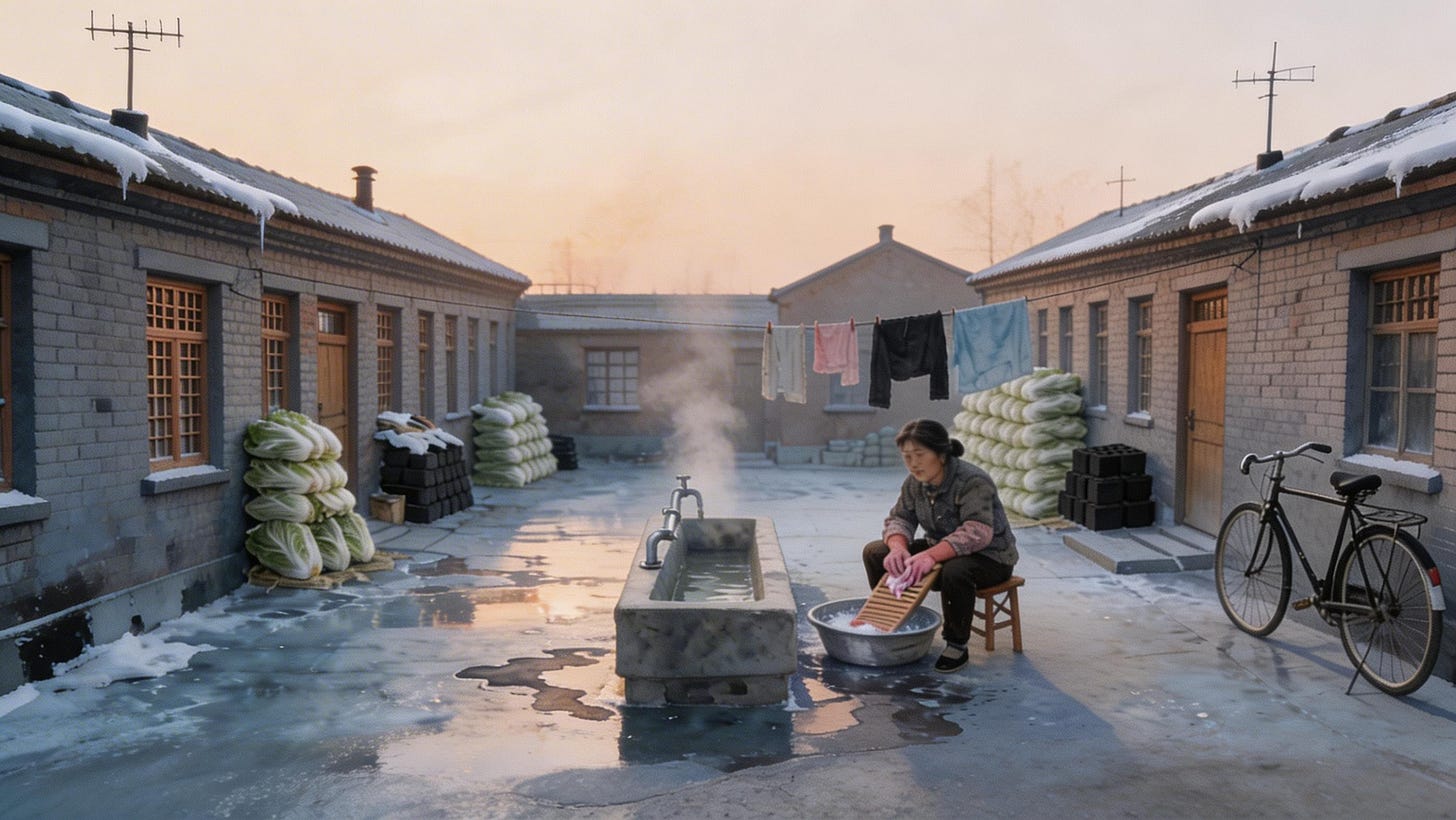
“How’s business today?” A neighbor called out in dialect, scrubbing clothes on a washboard with reddened hands. Clotheslines were strung across the middle of the yard, and several bicycles were parked next to her.
“Just so-so,” his mother replied as she parked the tricycle.
“At least it’s better than nothing, isn’t that right, college boy?” the neighbor said with a broad grin. Little Mouse forced a friendly smile. Then he and his mother lifted the goods and carried them into the unit they called home, like men bearing a stretcher.
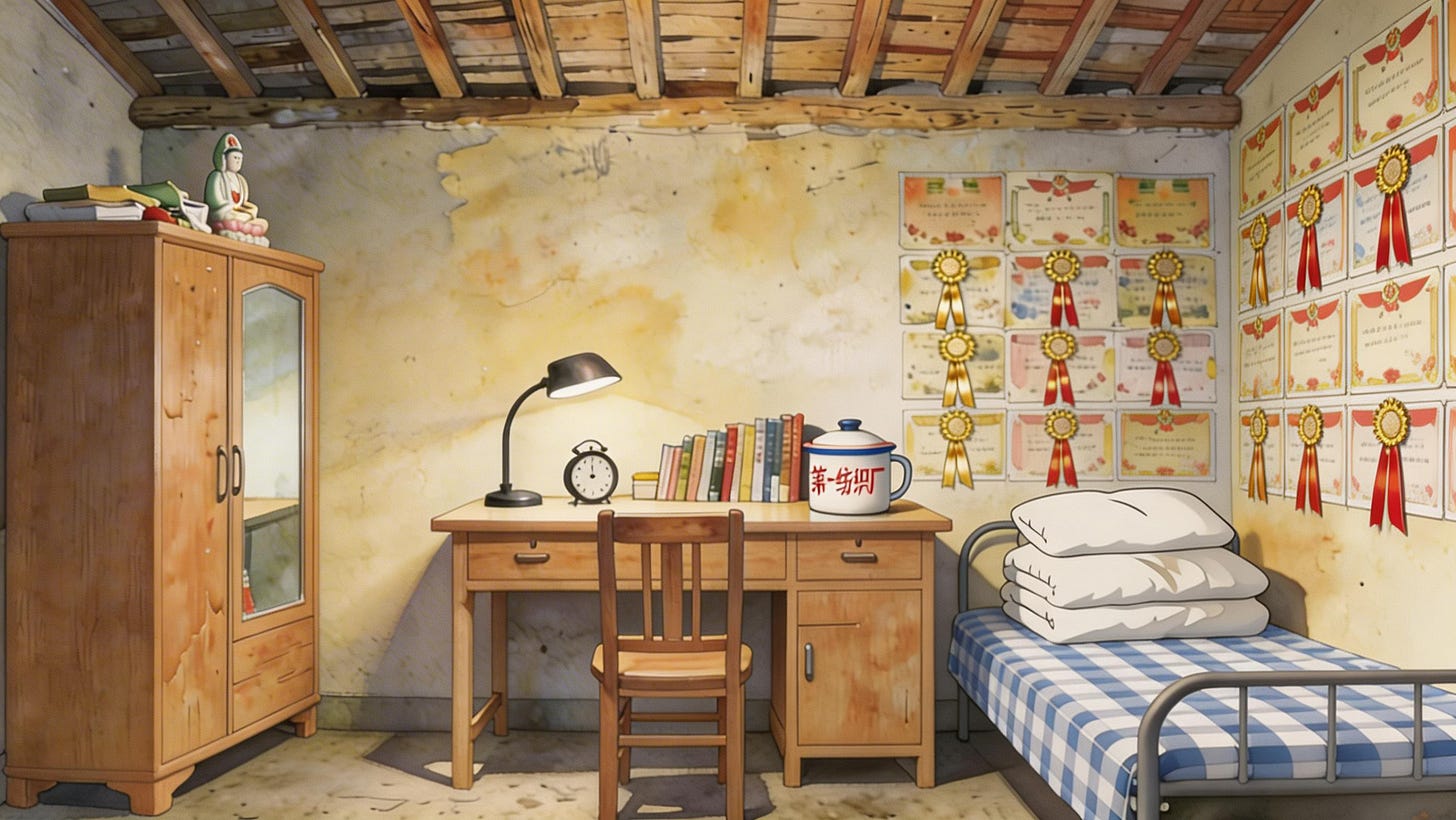
Opening the wooden door revealed a small, cramped two-room layout, each room measuring about one hundred square feet. A wooden study desk stood against the inner wall; on it were books, a desk lamp, an alarm clock, and an enamel mug stamped with bright red Chinese characters: “South Palace State-Owned Textile Factory.” On the left side of the outer room stood a wooden wardrobe, its door inset with a full-length mirror. On top of it, coated in grease and dust, lay a few odds and ends and a statue of Guan Yin, the Buddhist goddess of mercy.
Next to the wardrobe stood a reddish-brown bench and a washstand. Across the room, beside the desk, was the narrow single bed where Little Mouse slept. Two layers of bedding were spread over the wooden boards, topped with a blue-and-white checkered cotton sheet. The quilt was folded into a neat tofu-block shape and set against the inner wall, with a pillow resting on top. Something lay hidden beneath the bedding, raising the sheet into a row of shallow bumps like low dunes.
The wall above the bed was plastered with certificates of merit—paper trophies he earned at school over the years: “Highest-Scoring Student,” “First in Chinese Composition,” “First Prize in English Recitation”… The printed red-and-gold ribbons were the only things in the room that dared to shine.
The inner room served as the bedroom for his parents and his brother.
While his mother struggled to shove the fabrics under his bed, Little Mouse set down his schoolbag, took off his uniform, and walked to the washstand. With his head bowed, he scooped up a handful of water and splashed it onto his face. The cold water sent a sharp jolt through him, washing away the sweat from his labor.
“Don’t wash your face with cold water… You’re always too lazy to pour some hot water first,” his mother complained, straightening her back.
As Little Mouse lifted his face from the basin and wiped it with a towel, he noticed the ingredients for dinner sitting beside the stove. Of course, it wasn’t a real kitchen, nor a real stove, just a simple honeycomb coal burner used for both cooking and heating. A crude aluminum flue ran up along the window, then bent sharply at a right angle through a circular hole cut into the glass. The wall beneath the window was covered with pages of People’s Daily, yellowed by smoke and soot. On a tall wooden stool sat a few bottles and jars—cooking oil and various seasonings.
Beside the burner was a low dining table, which also served as a food-prep surface. On it were chopped napa cabbage, a few pieces of frozen tofu, and a pickled mustard root. A kettle sat heating on the stove, hissing as steam rose. No fridge, no microwave, no dishwasher—just how ordinary small-town Chinese families lived in the 1990s.
He had already been hungry that afternoon at school—the mess hall food was awful, and the timetable left barely enough time to eat—and now it seemed dinner was still two hours away.
“Any tests or quizzes today?” his mother asked as she turned back to prepare dinner.
“Yes. An English quiz. I got a ninety-five,” Little Mouse replied with pride.
“Where did the other five points go?” his mother demanded, agitation creeping into her voice.
“It was an essay question. Teachers never award full marks on that section. It’s just the convention.”
“Well, break the convention! I’m sure the teacher will make an allowance if you’re really that good.” She spoke as she took two eggs from a basket.
Little Mouse could have explained why it wasn’t possible, but he chose not to. Over the years, he had learned never to share unpleasant news from school unless absolutely necessary, for she always found a way to make it his fault.
“The school is asking us to pay ten yuan for a math practice book,” Little Mouse said, mentioning it only because it was necessary.
“Money again? Always more money and more money! The tuition alone is enough to consume a rural farmer’s entire annual income. I wonder if they’ll still be asking for money after you graduate,” his mother complained. She had a habit of measuring every expense against a poor farmer’s yearly earnings.
Little Mouse didn’t respond; he simply continued changing into his regular clothes.
As dusk fell and the light through the window grew dimmer and dimmer, Little Mouse walked to the center of the room and pulled the string to switch on an old-fashioned light bulb. The lonely light source hanging between the naked wooden rafters immediately cast a yellow glow downward. Better—but still full of shadows.
End of Episode
Albert Aspen’s work is published simultaneously on this site and on his Substack page. If you prefer reading on Substack, please visit: Who is Albert Aspen?
Check out Albert Aspen’s Audiobooks on Spotify: Albert Aspen Audiobooks.