Ep 08: A Gilded Snare Called Marriage
As I Wish – Chapter Mouse (8 Min Read) What do people always say? MARRIAGE IS HARRRRD!


Sitting at his desk, Little Mouse put on a show of looking busy, his eyes fixed on his homework—so his mother wouldn’t switch off the TV for being a distraction. In fact, he had already finished most of the day’s work during class breaks, filling in the blanks like a printing press, and the rest was far too easy for him. He sliced through it quickly—like fruit under a ninja’s sword—while half-listening to the TV drama in the background: Wang gradually grew close to the boss lady of the restaurant, and Guo slowly yielded to the white man’s quiet patience…
Before long, Little Mouse’s homework was done. He pulled out some scrap paper and, using the Oxford textbook as a guide, murmured softly as he practiced his English handwriting. “How do you do?” “How do you do?” “How do you do?” As he tirelessly scribbled away, he thought, “This must be ‘Standard English’—just like Standard Mandarin. If I learn it well, I can understand everyone from America.”
In that parallel world on TV, Wang started his own business and made a lot of money; Wang bought a new Cadillac; Wang moved into a large mansion on Long Island; Wang and Guo finally began living apart; soon, Wang and Guo flew their daughter, Ning Ning, from Beijing to New York, taking her shopping, dining, and traveling… like an American version of Lili Yang.
A quiet envy stirred within Little Mouse. Recalling Aunt Song’s words, he realized, “This could have been my life.” Indeed, if his parents dared to do what Aunt Song suggested, if they were brave enough to embrace the unknown, if they had the courage to take risks and forge a new life, he and his brother would be spared so much meaningless hardship and undeserved pain. Unfortunately, in the real world, there were no what-ifs.
“How do you do?” “How do you do?” “How do you do?”
Moreover, on TV, as a new immigrant and New Yorker, Ning Ning learned about her “rights” in America. When her father, Wang, raised his hand to strike her, she called the police on him, and he was arrested. Wang was furious because, in China, parents would never be arrested for “disciplining” their own children.
“How do you do?” “How do you do?” Little Mouse thought to himself, “I really need to learn English well. What if I go to the United States one day? There, hitting people is not allowed.”
“How do you do?”
“How do you do?”
“How could you be so stupid!” his mother snapped. Sure enough, the “fight of the day” between his parents began. Little Mouse couldn’t help but roll his eyes toward the inner room.
“You know nothing! You uncultured bumpkin!”
“It’s all your fault, city trash!”
In this household, these fights could happen anywhere, under any circumstances, without any warning. And the trigger could be anything—a buried grievance, an old trauma, a trivial miscommunication—the cause didn’t even matter; it would inevitably lead to a fight anyway. The agenda of the “fight conference” could be about money, about the children, about future plans, or just about slights neither of them could even remember clearly.
Whenever the horns of domestic war sounded, his brother would always try to do something—to mediate, to ease, to quiet things down, even though it never helped—while Little Mouse remained outwardly calm, watching with distant eyes, wishing he were deaf—anything to escape the real world. But the reality of these moments felt so precise, so solid, and so absolute that every detail was unshakable.
“This was definitely your fault!”
“How could it be my fault? I’m the one earning every penny you spend, yet you’re still not satisfied!”
“You were the one who didn’t agree in the first place—it wasn’t me who messed it up!” his mother’s voice trembling slightly. “I bore two sons for your family. I’ve done my part. When I was nursing the baby, your mother wouldn’t lift a finger to help!”
This time, his father didn’t shout back. He stormed out, took out a washbasin, ladled some cool water from the vat, and poured in hot water from the kettle. His lips clamped shut, each movement deliberate and forceful, as if he were holding back a flood. Then, sitting on a stool, eyes shut, he started a foot bath—like a boulder dropped to the bottom of the ocean.
From the clues given, Little Mouse immediately inferred the cause of today’s fight: when rumors of privatizing the state factory began circulating, Aunt Song came over and asked the couple if they were interested in joining her faction’s bid for about 80,000 yuan. There were no guarantees of success, but with the right connections, there could be a real chance of owning it. “Fortune favors the bold.” As the towering edifice of the socialist factory came crashing down, one either seized the upward rope and leapt—or stood still, watching the ruins bury everything. Even a child like Little Mouse could see that this was a once-in-a-lifetime opportunity. His mother borrowed the money and handed it over to Aunt Song, only for his father to demand it back the next day.
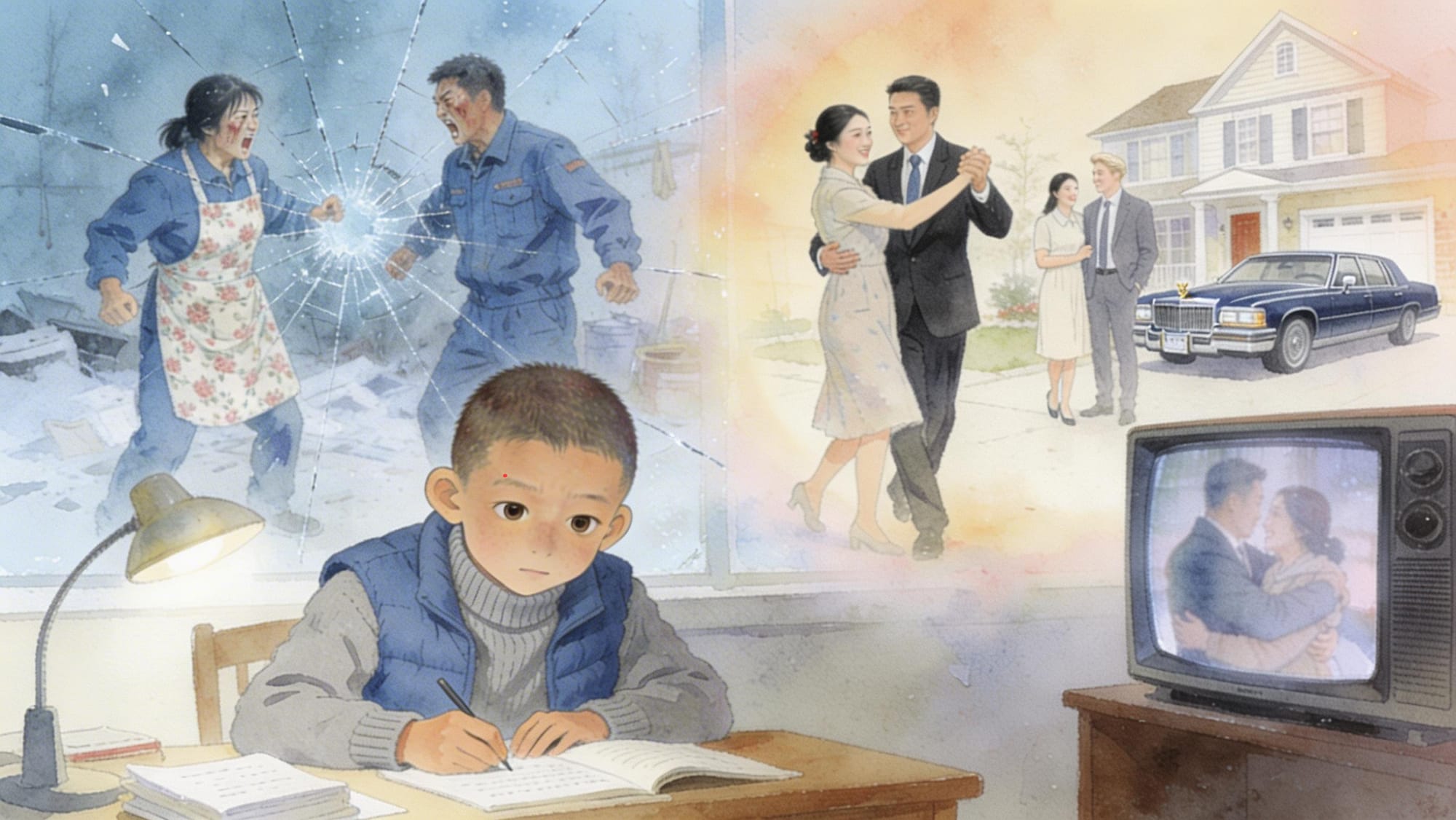
In all of Little Mouse’s memory, this duo had never reached agreement on almost anything—big issues like buying property and making investments, or trivial matters such as discarding worn-out socks and picking a route to visit relatives. Every time an opportunity arose and a decision needed to be made, the two would first argue over some minute detail, then escalate into a full-on fight, until the ship had sailed and nothing was left to chase.
Little Mouse might not yet be a “qualified marriage critic,” but he could tell his parents were not right for each other. There can’t be two immature quarrelers in a marriage; at least one must be the steady one, holding things together.
Unlike the children from those fake TV dramas and movies, Little Mouse had always wished for his parents to get a divorce—just as what was happening between Wang and Guo on TV. One time, he shared this wish with a neighbor. The neighbor burst out laughing. “What do you know about divorce? You’re just a kid!”
Adults always said, “Divorce would be too damaging for the children.” But no adult ever cared to answer the question—was a life steeped in daily quarrels any better for the children?
Gradually, Little Mouse came to understand that marriage was, in truth, their collusion. Despite all their shouting, two people who share the same bed are never as different as they appear. Deep inside, they were both gripped by an unspoken despair—every attempt would fail, every risk unacceptable. Most fatally, they were both oblivious to the world shifting around them. When an orderly socialist system suddenly became a vast capitalist casino ruled by the law of the jungle, the two of them clung to the past and took pride in refusing to gamble—their marriage only mirrored and magnified each other's limitations.
Beneath the rosy fantasies society endlessly peddles about marriage, the wrong marriage can become a grave for all of life’s possibilities.
By the end of the day, nothing would change. It takes great capability to get married, yet it takes even greater capability to get divorced. Society, tradition, and the very air they breathed rewarded them for staying together. If grander goals—getting rich, achieving success, building a better life—were forever out of reach, then “staying married” became the one virtue that cost them nothing, the easiest way to earn the world’s approval.
End of Episode
Albert Aspen’s work is published simultaneously on this site and on his Substack page. If you prefer reading on Substack, please visit: Who is Albert Aspen?
Check out Albert Aspen’s Audiobooks on Spotify: Albert Aspen Audiobooks.