Ep 11: Finally, Finally, New York, New York!
As I Wish – Chapter Bull (14 Min Read) When I'm talking about something else, I'm talking about sex.

Disclaimer: This is a work of fiction. Any resemblance to reality is, of course, coincidental.
“Office real estate is the future of investing. Who wouldn’t want a stake in it? Take a look out of my window—Manhattan’s iconic skyline is nothing but a forest of soaring office towers: the Empire State Building, the World Trade Center, the Chrysler Building… We represent one of the largest funds focused on office real estate in this city, and I am fully confident your investment will be richly rewarded. The outlook is extremely strong. So let me say this to every investor: this is a BULL STORY. A bright future awaits us all.”
Two computer monitors sat on the desk. The left displayed a video-conference interface densely packed with dozens of tiny windows—some dark, others occupied by staring big-heads. The right showed a draft in the Notepad application, with lengthy yet succinct prompt lines.
“Investing in our fund would absolutely be a wise choice. After all, if you don’t invest in a city like New York, where else in the world can you invest? New York is the capital of the entire human world in this era!” A lean young Asian man spoke in fluent American English, with a touch of theatricality in his expression. Earphones in, his pale skin catching a cold metallic luster, his hair cut in a tight skin fade, thin black frames resting on his face, a flawlessly professional smile fixed in place. Only the small crimson mole at the tail of his right eyebrow revealed that this was Little Mouse, decades later.
“We would welcome an increased level of investment from your institution,” he said. Then, suddenly—“New York… Concrete jungle where dreams are made of… There’s nothing you can’t do…” he burst into an Alicia Keys song, a half-step flat but full of excitement, rolling his shoulders toward the camera, fists clenched, as if riffing in jazz, eyes darting to the lyrics on the Notepad app. The staring big-heads on the screen remained utterly unmoved.
Meanwhile, a message popped up in the Microsoft Teams app.
Manager Mark: No need to come across as so desperate, Will.
Little Mouse—no, now his name was Will—reset his expression to composed and professional, then said, “Thank you so much for your time. I appreciate it.” Suddenly, something ignited from behind his ears across the back of his head. But his mind remained fixed on the meeting.
On the left screen, Mark’s window expanded across the conference grid, showing a white man with a touch of gray in his hair. “Thank you, Will. I’ll now pass things over to Raj from the IT department to explain the technical details of how we communicate sensitive data with stakeholders.”
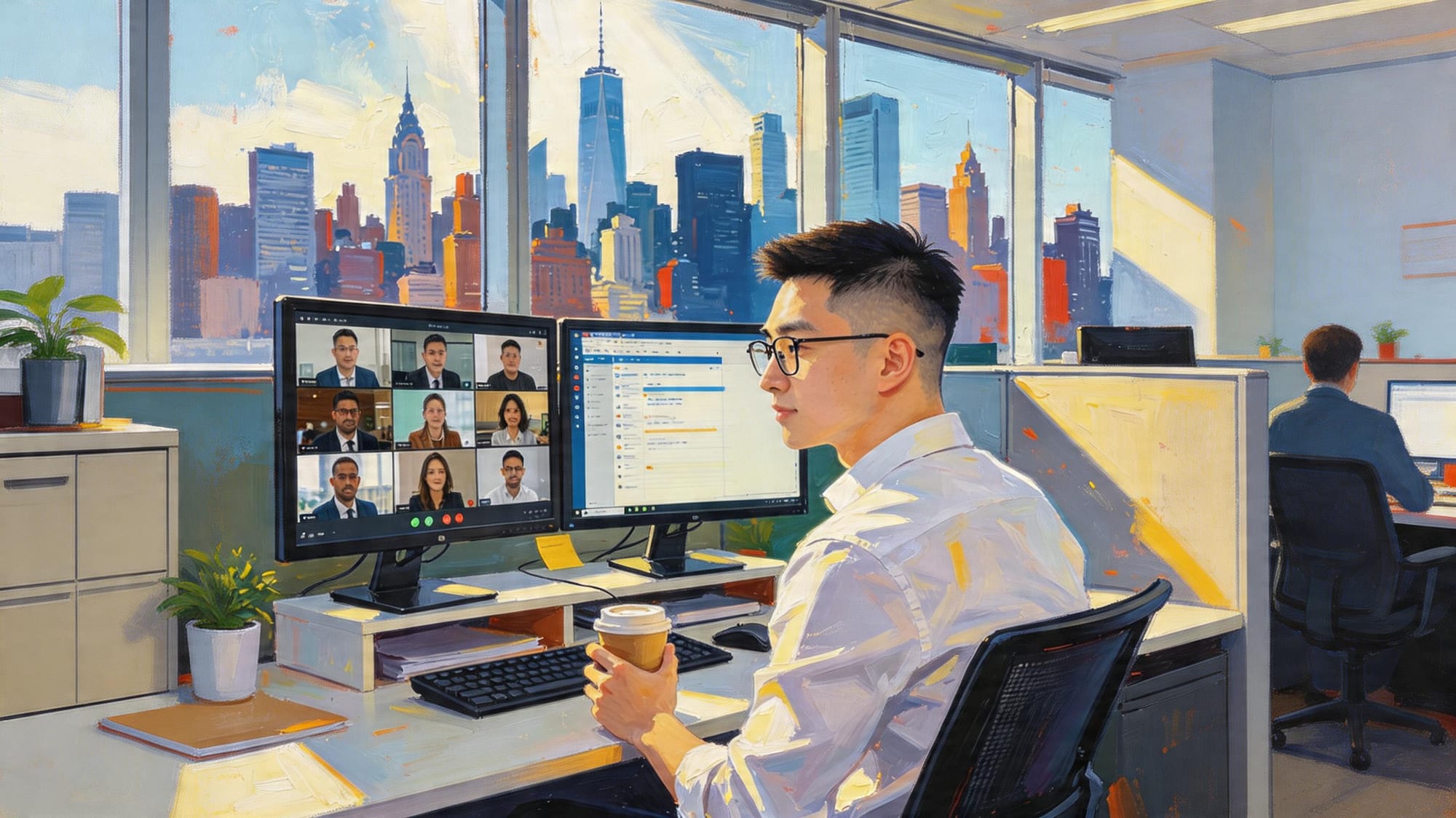
Then a window bearing the name tag “Rajdeyatabhaisajyaguru, Pamasabbauarimboqi” rose from the cluster of small screens. A round, smiling face with features tied to South Asia began speaking in English—or rather, his version of English.
Will turned off the camera and muted himself, his thumbnail window instantly blacking out. He picked out one side of his earphones, removed his glass frames with no lens, and stretched back. His hand found the base of his skull, kneading slowly. This headache had been haunting the left side for some time—even the faintest emotional strain would switch it on, like a circuit tripping behind his eyes. In the earphone, Raj went on and on. The few words Will could catch were “key data,” “automation,” and “algorithm”…
Although Will had met Raj in the virtual realm regularly over the past few years, sometimes even exchanging and clarifying important details, he still couldn’t fully pronounce Raj’s name, couldn’t quite recognize his face, couldn’t truly understand his speech—and, more importantly, he couldn’t show any of it; otherwise, he would be violating one of the greatest taboos of this globalized age—fake it, though unlikely to make it.
Every time Will had a meeting with Raj, whatever he said, the best way for Will to follow was to guess. Luckily, he had developed a set of safe, ready-made responses:“Thank you so much! I appreciate everything!” “Oh yeah! I trust your professional opinion.” “Absolutely! I agree with you.” “Whatever works. I’m sure it will be fantastic!” “Brilliant perspective. Let’s sort out the details via text later!” Text communication, however, was no easier. Sometimes Will recognized every word Raj wrote, yet still couldn’t grasp the meaning once they formed a sentence; apart from key nouns like money or time, the collocations and idiomatic usages felt entirely different. He fed Raj's words into AI once—and the AI stared back, equally lost. Did we learn the same English at all? Will wondered. Is it that I learned a pirated version—or that he did?
He also had no idea where this Raj was located—maybe somewhere in the United States, Canada, perhaps some city in India, or Nepal even! This great American Inc. had outsourced most of its jobs to the other side of the world anyway. Who gave a damn where he was, as long as he materialized out of the void and fixed whatever broke when a ticket was placed?
The internet had truly changed everything.
Will’s stomach rumbled. He checked the time on Microsoft Teams: 12:00 PM, then glanced to the right, toward the glass-partitioned office of Mark—not there. Great. Will pushed himself out of his chair and walked to the far end of the office, Raj’s voice still going in his earphone.
Stepping into the pantry, he looked around. Two glossy, barista-style coffee machines stood side by side, serving espresso, latte, cappuccino, flat white, café au lait… Beside them, racks displayed dozens of beans from around the world—Colombia, Guatemala, Sumatra, Ethiopia, even Yunnan, China, along with non-coffee options such as Japanese Uji Matcha, Taiwanese Mountain Oolong, British Royal Earl Grey, Indian chai, Belgian chocolate. Next to the rack, which held five kinds of sugar packets and wooden stirrers, stood a row of shiny pump bottles offering syrups—hazelnut, toffee, sugar cookie, caramel, vanilla, sugar-free almond… Snacks lined the opposite counter: kettle chips, Twinkies, frosted cookies, peanut butter bars, cinnamon donuts… American stuff is always so crazily greasy and sweet. To his left sat a round fruit tray—yellow bananas, red strawberries, purple grapes, green apples, pink melon slices. He turned around and pulled open the heavy steel double doors of the refrigerator, like the gates of a vault, and frowned: only a few rows of red cans of Coca-Cola and blue cans of Pepsi remained. The diet sodas, Fanta, orange juice, lemonade, and energy drinks were all gone. The Greek yogurts had vanished; even the flamboyant bottles of ginger kombucha had been taken. He shut the doors and checked the cabinet below the counter: nothing but Oreos, mixed nuts, and raisins. None of it appealed to him. Will reopened the refrigerator, reached behind a stack of lunch boxes, pulled out a bottle of Acqua Panna, and walked back.
They really should restock more frequently, he thought, as he hurriedly grabbed the mouse to shake his status from yellow “away” to green “present.” The glare from the opposite window caught his eye as he lowered himself into his chair; he found himself looking toward it.
Outside the glass wall in front of his desk, across Pine Street, stood another skyscraper—an office building recently converted into residential apartments. Only a few dozen feet away, he could see the unit across from him through its large window. Apparently a new tenant had moved in while Will worked from home these past few days.
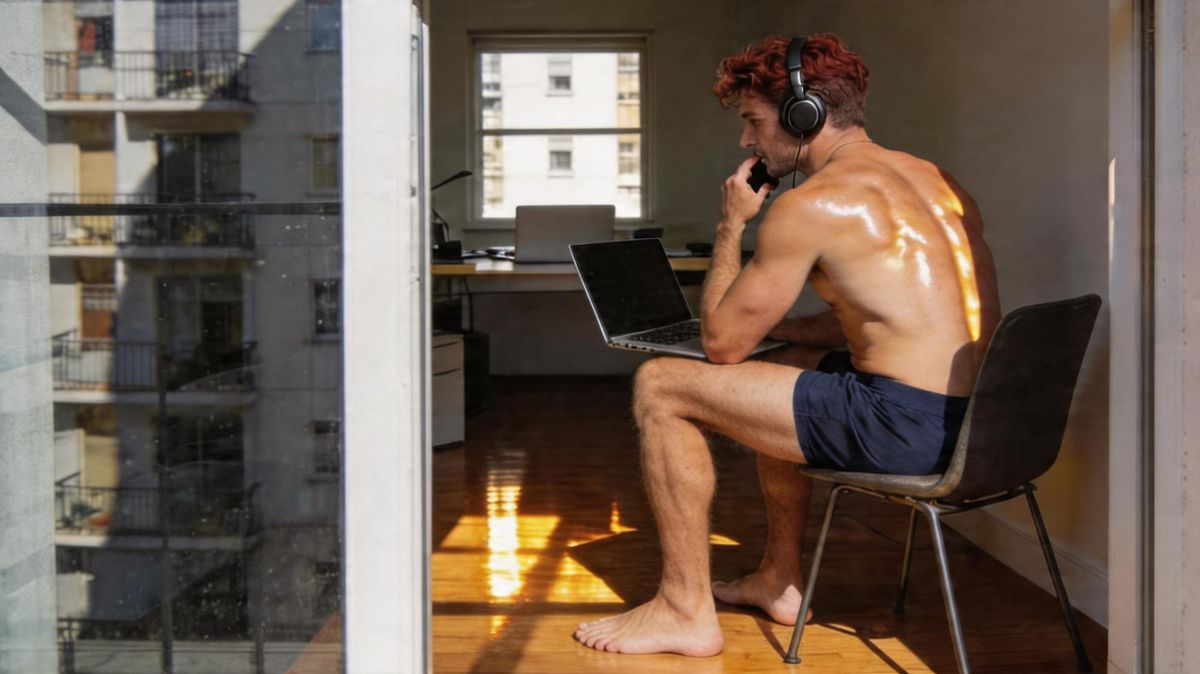
The bright midday sun spilled into the apartment, setting the oak floor aglow. Just beyond the reach of the light, a white man, thirtyish, sat sideways at a desk farther inside, on a call. Headphones pressed over his wavy chestnut hair, beard neatly trimmed, bare feet flat on the floor, he was undressed save for dark blue boxer briefs. His broad back muscles caught the reflected light from the floor, as though brushed in cream. Suddenly, he paused. Long fingers curled to hook one side of the headphones off his ear. He said something to the laptop, then closed it. Setting them down, he rose—easily six feet tall—and walked to the far end of the apartment, opening the door. A young woman stood outside, her straight, dark blonde hair falling to her shoulders. She smiled and leaned in, brushing her cheeks against his on both sides. She handed him a red paper bag and stepped in, her fingers rising slowly to her chin, drawing down the long zipper of her cashmere coat. The man set the bag on the desk, turned, and walked straight toward the window. Before his lower body reached the sunlight, Will quickly ducked beneath the cubicle partition.
Three seconds later, Will lifted his head again, only to see that the curtains were already drawn, their skin-toned fabric swaying…
Just then, Raj’s voice finally wound down. Mark said a few words and ended the call. Shortly a message appeared on Microsoft Teams:
Manager Mark: I have to cancel our one-on-one at 1:00 PM.
Will: Okay. No problem!
Manager Mark: HR just squeezed in a required meeting. I need to head to the 18th floor.
Manager Mark: IR is dissatisfied with the sales number, which may impact AUM.
Manager Mark: We’ll come back to this later.
Will: No problem. Thanks for letting me know!
Manager Mark: Hopefully “You Know Who” won’t say anything stupid on social media.
Oh yeah—“You Know Who.”
On a Friday like this, everyone in finance had the same quiet prayer: that “You Know Who” would not say a word online.
“You Know Who” is a figure beyond easy description. He was a bomb with no clock—no one knew when he would go off. The year Will arrived in the United States, while this country still had its grace, “You Know Who” declared his bid for the presidency. Then he really won—and took office—and smashed the American elegance to pieces. Worse still, no one seemed able to rein him in. “You Know Who” would erupt on social media without warning, like a man unmoored. All too often, his erratic outbursts would send the markets into turmoil. And nobodies like Will—ordinary office workers—were left scrambling to absorb the shock: price swings, emergency meetings, report after report.
The internet had truly changed everything.
Will couldn’t understand how a country so proud of its systems could fail to contain a single man. Wasn’t power supposed to be regulated? Then why is he charging around like a loose rhino in a glasshouse?
Anyway, there was nothing he could do—he might as well step out for lunch. Will picked up his wool coat and badge. “Right!” He hurriedly walked to the restroom, took out a plastic bottle, popped two pills into his mouth.
End of Episode
Albert Aspen’s work is published simultaneously on this site and on his Substack page. If you prefer reading on Substack, please visit: Who is Albert Aspen?
Check out Albert Aspen’s Audiobooks on Spotify: Albert Aspen Audiobooks.