Ep 09: Magic Sealed in Books
As I Wish – Chapter Mouse (9 Min Read) Promise me one thing: Do NOT Judge His Mother After You Read. Thank You!

When the TV drama ended and the 10 o’clock news began, a sudden gale set the windows rattling, followed by heavy raindrops slapping against the glass. His father rose from the stool at once and walked barefoot to the corner by the door. Lifting the broom, he hooked the breaker with the handle and yanked the switch down. Darkness flooded the room—even the television fell silent.
Yet the wooden bench erupted into percussion, like mallets striking timpani—the roof leaked every time it rained, and the leaks appeared at random, sometimes here, sometimes there. Soon enough, the desk, the floor, the chairs in the inner room, and the washstand joined the percussion, layering in bass drums, side drums, and vibraphones. The family hurried about again, scrambling for whatever pans, pots, buckets, and woks they could find to catch the water dripping from the roof. When his mother was finally able to straighten up, she held a flashlight and called out to Little Mouse, “It’s about time to go to bed anyway. You’ll need to get up early tomorrow for school.”
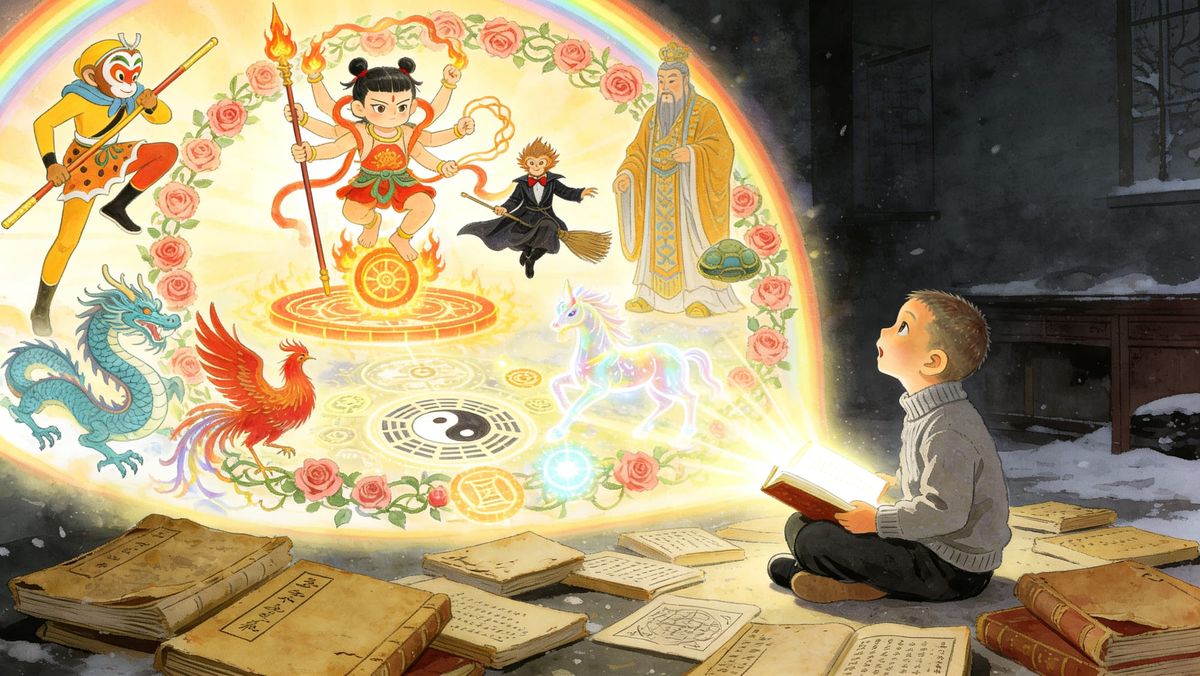
But abruptly, Little Mouse remembered there was something he needed to rescue. He pulled over a stool and stacked it atop the bench, then climbed up with great care. At last, he reached to the top of the wardrobe. From beneath that pile of odds and ends, behind the dusty Guan Yin statue, he gently eased out some yellowed, thread-bound books, cradled them in his arms, and carefully climbed back down. Holding the books up to his eyes, he examined them and felt a surge of relief—they hadn’t come into contact with the rain.
Those were his “Magic Books.” They were so old that some were handwritten rather than printed, all in traditional characters, not simplified ones, and written in archaic, obscure Classical Chinese rather than Modern Chinese—like intricate manuals encrypted beyond easy understanding. Some contained strange, confusing poems and drawings; some bore Yin–Yang symbols; and some were filled with arcane sutras in Sanskrit…
“Somewhere in your home—in some hidden corner—there is something that can save you.” Was this the “something” the Taoist had spoken of? he thought to himself.
Little Mouse had yet to decipher those books—he wasn’t even sure what they contained: astrology, alchemy, spells, or powers he couldn’t name. He loved mythology above all else. In Chinese legends, for example, Emperor Zhen Wu commanded formidable powers, wielding his Polaris Sword to sweep away demons and dark forces, and sometimes Little Mouse pictured himself mastering such arts, becoming like the Monkey King he saw on television—golden light shooting from his fingertips, riding the clouds, summoning glimpses of the past with unknowable magic.
He had also read Western myths; only Greek mythology could rival the imaginative scale of the Chinese mythic world—but the powers of the Greek gods were, frankly, hard to take seriously… Even Zeus—the morally dissolute king of the gods—seemed perpetually drunk: one moment all-powerful, the next embarrassingly clumsy. And, for no particular reason, Little Mouse simply couldn’t stand Zeus.
The elders used to say that Taoism and Buddhism were rich with such arts—that they were real—and that practices like feng shui and fortune-telling were merely the threshold. Yet since “Liberation,” such knowledge had been driven into silence, dismissed as feudal superstition.
School would definitely not teach anything related to those books—he was part of a proudly legitimate and modern national educational system, one that advocated science, atheism, and an unconditional, fervent devotion to Marxism and communism. Any traditional study or knowledge, be it Confucianism, Taoism, or Buddhism, was simply cast as obsolete, unorthodox, and metaphysical, even though these traditions had shaped every Chinese person from the inside out. Once, he took one of the books to his Chinese teacher to ask about a few passages, only for the teacher to look up and say: “All this ‘mystical nonsense’—can you see it? Can you touch it? If it’s invisible, it isn’t real.”
Little Mouse could not challenge the teacher, yet deep down he knew the teacher was the one who was wrong. He couldn’t fully articulate it—not yet—but he had a vague sense that, in fact, the visible world moves at the command of invisible forces. He had seen it himself: those hospital doctors denounced acupuncture as mere witchcraft, yet their director still had her lifelong pain cured by his father’s needles. Whoever first discovered that inserting fine silver needles into specific points could heal the flesh must have been a genius…
“Hurry up and go to sleep. You have school first thing tomorrow—who has time for these things? They should be thrown in the trash!” His mother didn’t approve of anything that wouldn’t help his exam scores. “You’ve read too much extracurricular nonsense—now you can’t focus on your studies. Hobbies will ruin you! I never should have helped you get those books in the first place.”
Since he was a child, Little Mouse had shown talent and potential in multiple fields: dancing, acting, painting, engineering, and singing… And, of course, his mother nipped them all in the bud—except for one. The only hobby he was allowed to pursue, which thankfully might help his exam scores, was reading. Any book, any newspaper, any manual—anything printed could easily draw Little Mouse’s attention and pull him in. But books were expensive and unnecessary to purchase, as they would only be read once. All she needed to do was make sure her son had enough pages to chew through—at no money cost.
She was resourceful and quick to solve problems: she remembered that one of her high school friends was the librarian at the only public library in town, a deeply underfunded, two-person public-sector unit. She pedaled her tricycle to the library; with her friend’s help, she swept a few rows of books right off the shelves, dropped them into the tricycle’s large cargo box, and then pedaled the loot home with swagger. One summer, she did this several times. Fortunately for Little Mouse, during the years when his thirst for knowledge was at its peak, those books became his spiritual Eden.
Please! Don’t use your modern, developed-country lens to judge her! It was different: the library looked more like a hollow on the street than a hall of knowledge. The newest books there were from the 1960s, when the library could still get funding. By the 1990s, most of the books had already yellowed. Some were so old that the librarian didn’t even want them back: it was much easier to report them lost than to request repair funding from the city council. If you evaluate the situation with a clear and fair mind, you would agree that those books sitting on the library shelves were no better off than if they had been left in open trash bins on the streets of New York.
“You are likely to encounter a grave crisis in your thirties….there is something that can save you.” Remembering the Taoist’s words, Little Mouse felt a strange bond with those orphaned “Magic Books.” He carefully placed them in a safe corner of his desk, laid several exercise books over them, and only then made his bed for sleep.
End of Episode
Albert Aspen’s work is published simultaneously on this site and on his Substack page. If you prefer reading on Substack, please visit: Who is Albert Aspen?
Check out Albert Aspen’s Audiobooks on Spotify: Albert Aspen Audiobooks.