Ep 10: When the Wheel of Fate Turns
As I Wish – Chapter Mouse Finale (12 Min Read) In that moment, his wish awakened. And the magic began.

As the hands of the clock reached eleven, the room finally sank into a dead hush—only the winter rain fell cold and relentless, while the second hand advanced, reminding him that time, like a train, never waits.
11 o’clock marks the beginning of the Hour of the Mouse. In Chinese reckoning, a day is divided into twelve units, each spanning two hours and named after the animals of the zodiac. Together, they form an unbroken order, to which all things are bound. At the Hour of the Mouse, the world retreats into the deepest peace of the night, and the energy of Yin—the dim, the passive, the cold, the frail, and the inward—reaches its peak. Yet, within that innermost stillness, in that utter silence, the first trace of Yang—the bright, the active, the hot, the robust, and the outward—begins to rise. By this hour, a new day is already underway.
Little Mouse lay in bed, tossing and turning, unable to fall asleep. The bone at the back of his head—the “Rebellious Bone”—pressed against the hard pillow. Beneath the bedding, hundreds of plastic bags gathered over the years had formed a cloud-like layer; the slightest movement would disturb them, setting off a chorus of creaks and crinkles. The old cotton quilt covering him gave little warmth, only weight.
He worried, faintly, that not sleeping might make it harder to get up in the morning. But the whole of his day was claimed by school and family, where he had to be a top-performing student and a good, undemanding son. Only here, on the verge of sleep, did time become his own; he could drift through wandering thoughts. Only now was he free.
His eyes wide open, everything around him blurred into gray hues, like the endless winter rain—it would not freeze him to death, but it bore down on his childhood, heavy and unrelenting. He could not name what unsettled him: was it near-term fears like possible homelessness, the quiet brutality of school, and critical parents, or distant ones like the exam that would seal his fate and the joblessness after sacrificing so much for an education? He could not yet tell.
On the desk sat a ten-yuan note for school the next day. “We are poor,” his mother said when she handed it to him—she always did. Little Mouse grew ashamed whenever he had to ask for something, as if he were in the wrong. He sometimes thought that if he had never been born, he would not have had to spend his parents’ money, nor would he have had to carry that constant guilt. Of course, his mother never truly left him without what he needed. But he understood that every single penny he received came with conditions: they expected a return—an outsized one.
Even with parents, he felt like an orphan. Inspired by his chemistry class, he began to see their feelings toward him as a mixture rather than a pure substance: there might be elements of love, but it was far from pure.
His parents were nothing exceptional; they were simply ordinary people shaped by their time, like every man and woman of that generation—a generation that clawed its way out of famine and terror but remained bound by its limits, trapped by its desires. They unwittingly carried forward the thousand-year-old tradition: to raise children as livestock. Children were the instruments of their elders’ will, investments to be weighed for return, and lifelong debts they could neither repay nor escape. To Little Mouse, this so-called human society was nothing but a scheme that preserves itself by binding the next, without ever asking consent.
“No wonder babies cry at birth—they must feel they’ve been duped,” he thought. “Are there any sad children on the other side of the world, in America—the Beautiful Country?” Just as he could not imagine how children in the United States really lived, perhaps those American children could not imagine what he, a Chinese boy, was going through either.
As he lingered in thought, a raindrop struck his forehead—the roof leaked there as well. He rose quietly, fetched a plastic basin, set it on the bed, then shifted head to foot. Thankfully, he was still small enough to share the bed with it. Eyes wide open, he rolled onto his left side. Now he could see this room from an angle he had never known.
“You will journey far from here, child—in a distant land, your future awaits.” The Taoist’s words flashed through his mind.
Is it true?
Is this really going to happen?
What is life in that distant land like?
Is it really like what they show on TV?
He recalled what Aunt Song had described and began to imagine how beautiful that place must be: it must be full of fancy restaurants like McDonald’s; it must be overflowing with luxurious Coca-Cola and Pepsi; and it must have beautiful furniture just sitting on the streets, waiting for people to take home!
“I want to leave here!” Like a flash of lightning, the thought crossed his mind.
He was startled by it immediately—almost frightened.
How could I think that?
Is it a betrayal?
Am I betraying my family—where I come from?
If I am not happy here, don’t I have the freedom to leave?
However, he had nothing to bargain with life. Like a hatchling on a conveyor belt, he could only wait to be sorted, unable to resist.
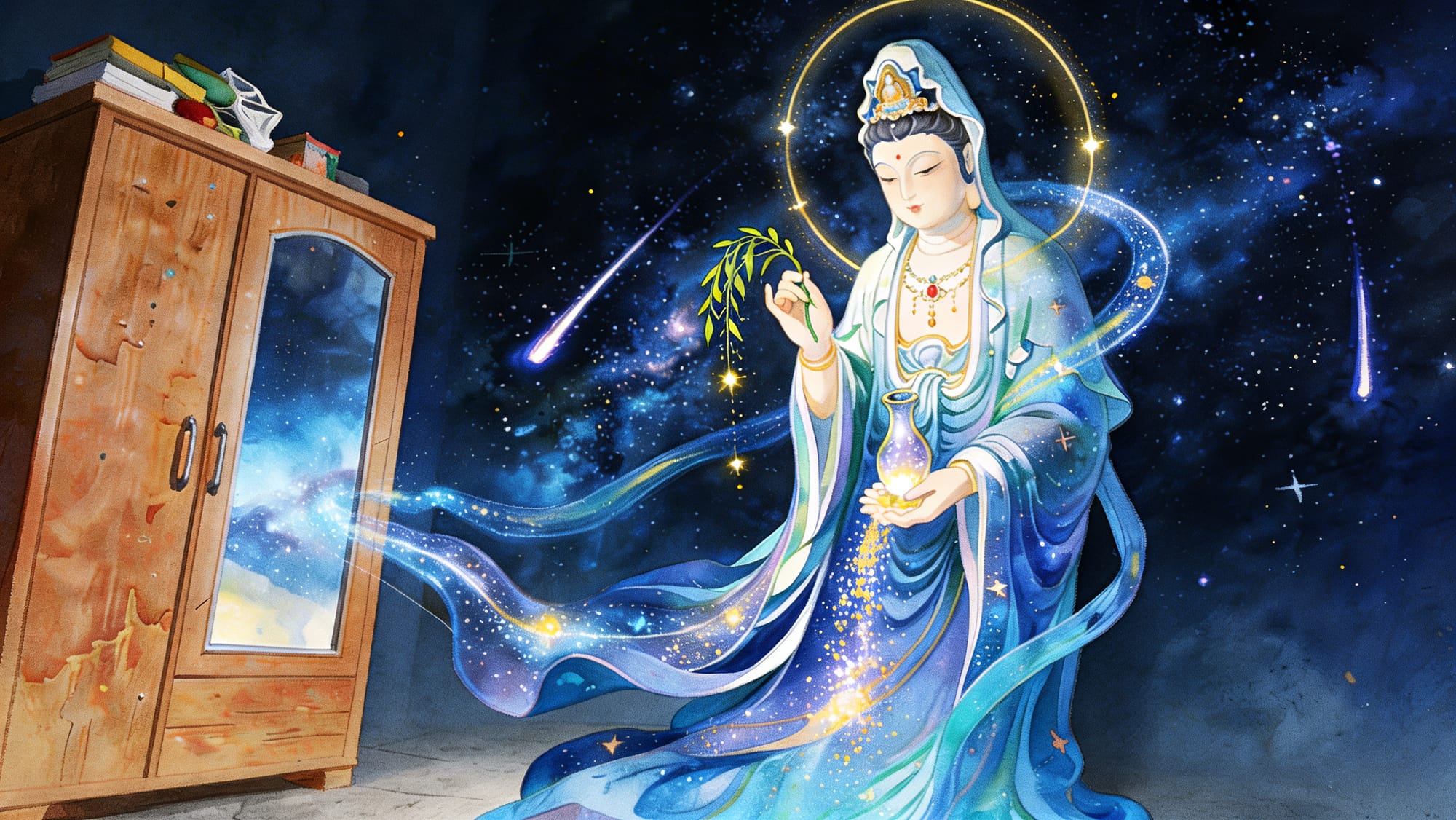
In an instant, a bolt of lightning split the sky—rare in winter—flooding the entire room with light. Pans, pots, and woks lay scattered across the floor. The washbasin, the desk, the “Magic Books,” the wardrobe, the mirror—and atop it, the Guan Yin statue. She sat upright on her lotus pedestal, an emerald willow branch in hand, her half-open eyes fixed on Little Mouse. If the statue were truly the almighty Guan Yin, then nothing in this household had escaped her gaze.
“Only rebellion could open the way to a new life.” The thought struck him suddenly, like a small flame flickering to life in the depths of the sea. Little Mouse was too young to know what he truly wanted, but for the first time in his life, he was certain of one thing: he did NOT want a life here. “I am only escaping.”
A moment later, another flash of lightning split the dark, its light flaring across the mirror. He froze as he saw Guan Yin raise her willow branch—then the mirror’s surface beneath her opened into a vast expanse of stars, turning silently, counterclockwise. As thunder boomed, his soul seemed to slip free of his body, drawn into an endless tunnel, rushing forward at great speed and yet not moving at all. The air softened around him; he sensed a fine, luminous mist unfurling, and caught the subtle, damp breath of spring, as if the lightest drizzle had dissolved into the air. He stood outside time and space, watching his destiny unfold through the fog, winding toward horizons.
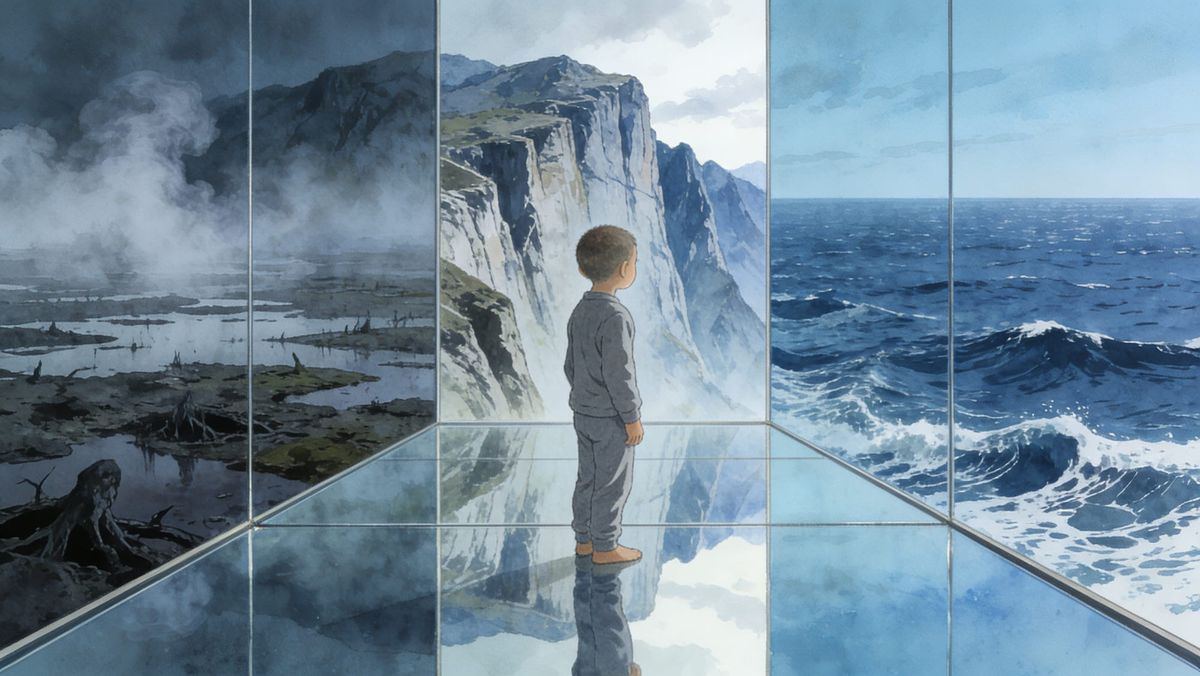
Many years of his youth must be sacrificed for the freedom to choose. Before him lay a vast, treacherous swamp of fate—one he had to wade through, regardless of the dangers and the mire. Beyond it rose high mountains that would demand immense effort to climb. He would pass over those colossal ranges and into vast blue heavens, where birds skimmed the open sea: a great ocean awaited him. He would meet the wind head-on, sing without fear, and see every landscape the world holds.
At that moment, he felt a pair of eyes fixed upon his back. He did not turn around, yet he knew, it’s Xuan Wu, the Taoist he met at dusk. Little Mouse cast his eyes ahead and saw a torrent of images collided: he had to grow like a cactus in the desert, fight like a gladiator facing a lion, and endure like a violet seed buried through the winter... Life was nothing but one brutal exam after another, and he had to win every round. There was just no other way.
Gradually, the fog gathered once more over the map of his destiny and hiding it from sight. As the last traces of it disappeared into the mist, Xuan Wu’s voice rang out behind him, calm and majestic:
“Go Forward, Child. Don’t Look Back!”
Seconds later, he finally returned to himself, and oddly, he felt quite peaceful. Everything had become clear—only two forces would define his fate: time and resolve. He closed his eyes. As sleep drew him under, he heard himself murmuring within:
As I wish,
Time, lift me from despair, struggle, and scarcity.
Carry me into hope, success, and abundance.
Time—grant me this.
As I wish.
End of Episode
Albert Aspen’s work is published simultaneously on this site and on his Substack page. If you prefer reading on Substack, please visit: Who is Albert Aspen?
Check out Albert Aspen’s Audiobooks on Spotify: Albert Aspen Audiobooks.