Ep 04: The "People Up There"
As I Wish – Chapter Mouse (13 Min Read) Remember this boy as he is now. Soon, everything will be re-written.

“It’s still a bit too early to turn on the light. A waste of electricity.” His mother immediately objected. Her policy for running the household was simple: everything had to exist in the most cost-efficient way. The budget covered only the basics—the bare minimum. Not a penny was to be spent on anything “unnecessary.” No splurging. No wasting. Always save for the future.
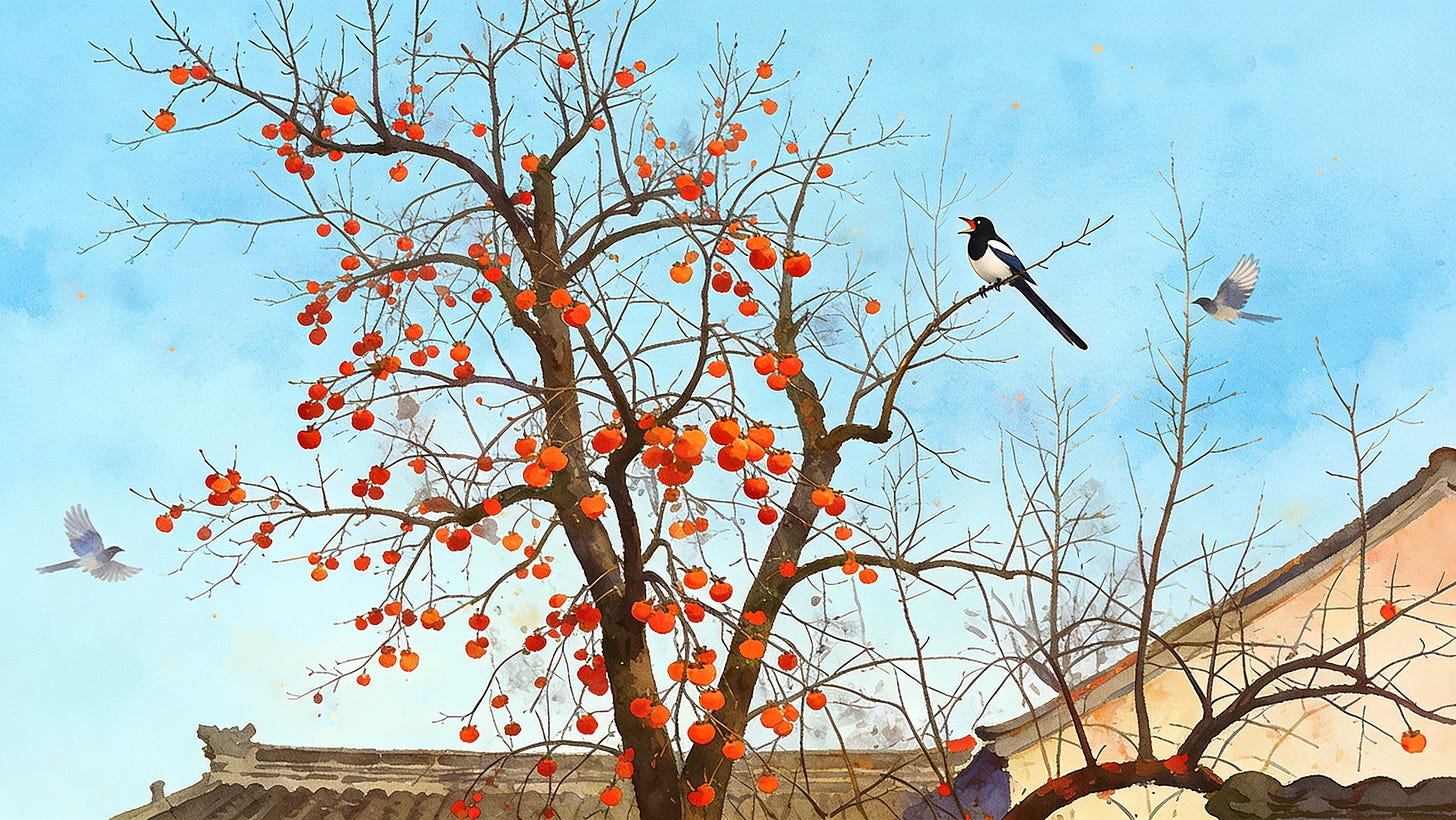
A moment later, through the glass, she saw a man stepping into the yard.
“Stay inside. Now. Be quiet.” His mother ordered, her eyes fixed on the man approaching, “And turn on the television.”
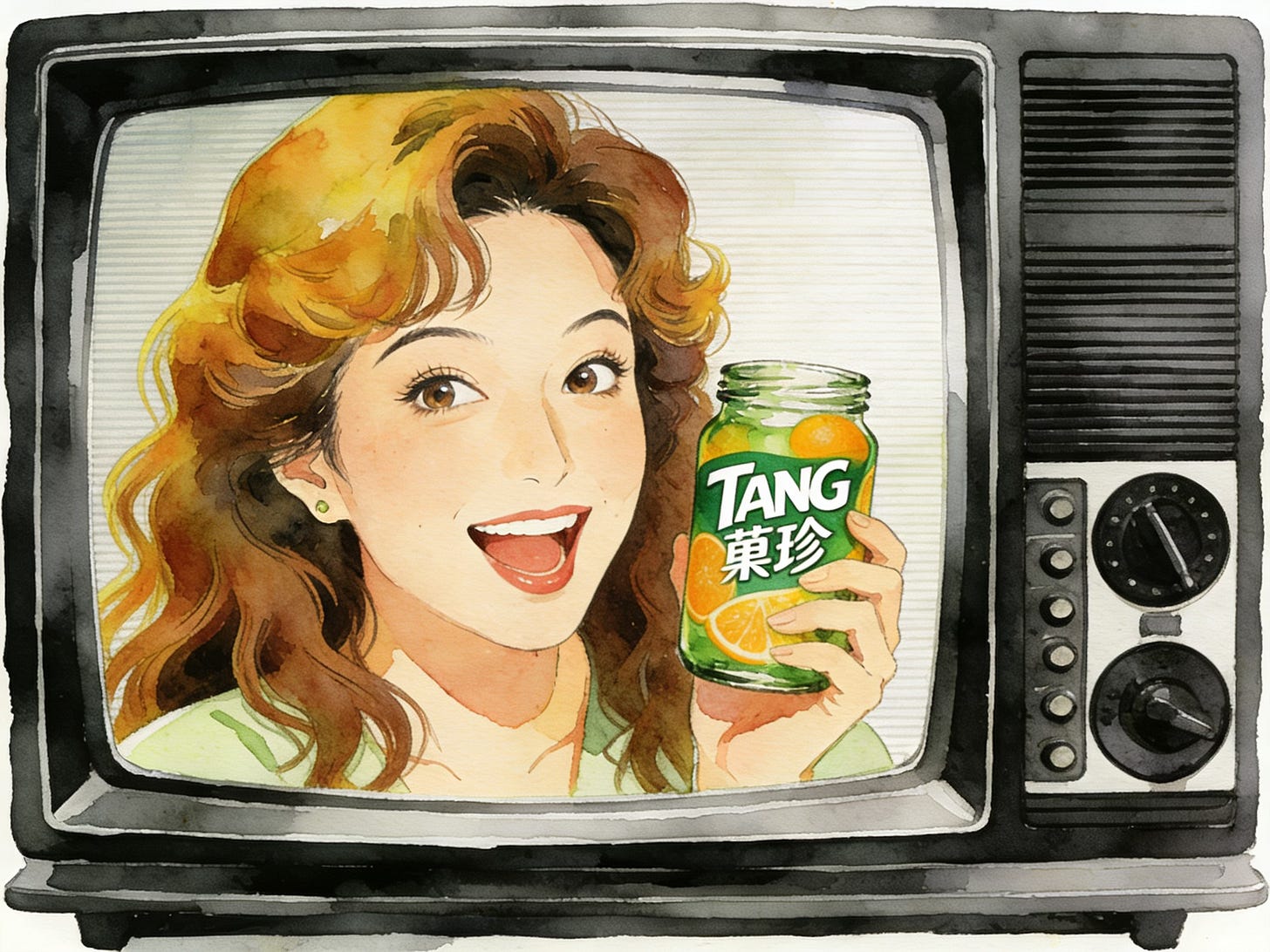
Placed against the interior wall of the inner room, the bulky 14-inch black-and-white television was the only modern appliance in this household. It was also his only window onto the outside world. Little Mouse walked in, reached for the knob, and turned it clockwise with a sharp click. He felt faintly fortunate: in the 1990s, children were often forbidden to watch TV without explicit parental permission. This uninvited visitor brought him a rare chance to watch the most popular show airing that hour—the American sitcom Growing Pains.
Once the TV flickered on, Little Mouse saw the Seavers—a family living in Long Island, New York—gathered around the kitchen table of their beautiful, spacious house, bantering about school, work, and dating. Mike made sarcastic remarks, Carol corrected him, Ben cut in, and their easygoing mother, Maggie, smiled as she served dinner. The Standard Mandarin voice-over did not dampen his quiet laughter; he found himself unexpectedly amused by this cheerful family on the other side of the globe.
Before long, a greasy man with a protruding belly pushed the door open and walked in without knocking or waiting for an invitation, like a rampaging iceberg.
“Cooking?” he asked in dialect, twirling the key to a Volkswagen Santana around his finger; a brick-sized Motorola pager bounced on his belt as his belly shook with each movement.
“Yes! Stay for dinner, Chief Dong,” his mother answered with practiced ease.
“No, no. Mine is preparing dinner too.” His voice was low and matter-of-fact. He said “mine,” as everyone did in the dialect—no one said “my wife.” People referred instead to “my kid’s mother,” or simply “mine.” There were no “hello” or “thank you” in the dialect, either.
“I came for the same reason as last time.” After the usual small talk about food, Chief Dong got straight to the point. “This whole place is going to be torn down to build a new complex. It’s mandatory to relocate.” Seeing that she didn’t respond, he continued, “You know, the ‘people up there’ have instructed us to clear out anyone who is no longer a staff member, so you…”
“You people don’t keep your promises. When we accepted the layoff, we were told that we could still live here.” His mother held her anger in check.
“That was then; this is now. Things change. The decision has already been made.” Dong said. “The latest directive from the ‘people up there’ calls for accelerating the pace of urban development.”
“This is collectively owned property. It belongs to the state-owned factory, and the government assigned this place to us,” his mother argued.
“Yes, but as part of Reform and Opening-Up, the state-owned factory has become the Five-Star Export Company. This property now belongs to a private enterprise…” Dong then pointed a finger at Little Mouse inside. “…of which his dad is no longer an employee.”
Just then, the kettle on the stove made a sharp urgent whistle, steam rattling its lid.
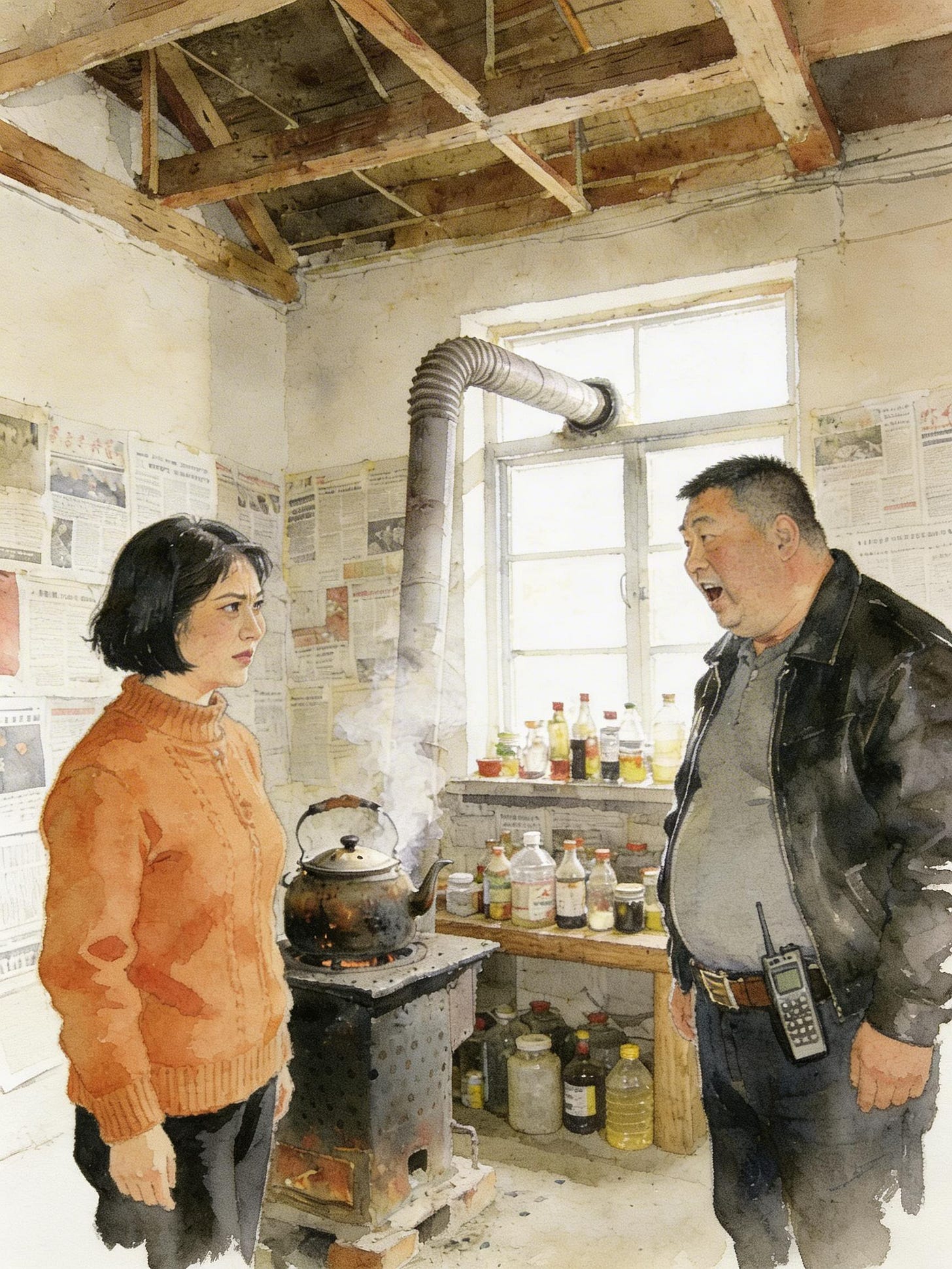
His mother walked over, removed the kettle, and poured the hot water into a flask, as she continued to argue. “The news said the specific conditions were to be worked out by each unit—that’s what the government says. There’s no one-size-fits-all policy, especially for someone like his dad, who spent almost twenty years working for this state factory.”
“Yes, ‘work out by each unit’—the company has already worked it out. This is a decision made by the ‘people up there.’” Dong stopped twirling the key and pointed upward.
In the brief silence that followed, laughter and sassy dialogue from the television filled the room. The Seaver family appeared blissfully harmonious, suffused with joy, comfort, and abundance—as if suspended in their perfect sitcom heaven.
“Why can’t you show our family some consideration?” his mother finally shouted.
“What?! Be careful what you’re saying!” Dong snapped. “How much more do you expect me to do? You set up that little stall outside the gate—ever wondered why the Business Administration people never bothered you? Because I told them to leave you alone. And when you asked for my help getting the birth certificate for your younger son, did you forget—” Dong stopped himself as he realized Little Mouse was present.
At that moment, Little Mouse finally figured out a long-term puzzle in his mind: as the second child of this family, he shouldn’t have existed. Yet he did anyway—real in the world but not legally, until he was four, when his parents sent him to elementary school after discovering that kindergarten would cost more. The date of birth on his paid-for official record was fabricated so that, on paper, he had reached school age. His mother often nagged about the money spent on this matter, yet she never mentioned who made it happen. Now it seemed Chief Dong must be the person behind it all.
“You both have no steady income, yet you have two sons to feed. I understand your situation. But the decision has already been made. This is not the old days—you can’t expect to rely on the state or the government forever.” Dong delivered his final warning before heading out. “Your family must vacate this unit by the end of January, or company security will enforce the decision. You have been officially notified.”
Watching Chief Dong’s figure recede into the distance, his mother snarled through gritted teeth, “Always and always, either orders from the ‘people up there’ or instructions from the ‘people up there.’ Bah—what ‘people up there’? Aren’t you the one making the decisions anyway? Those who bribe get a place to live; people like us, too poor to bribe, get thrown out onto the streets. Bunch of bastards!”
The millet porridge in the pot began to boil and churn; white foam surged upward. His mother hurriedly poured half a bowl of cold water into the pot to bring it down. During a commercial break in Growing Pains, a woman with permed curls appeared on the screen. Holding a large canister, she cheerfully delivered the slogan: “TANG Drink Mix, Authentic American Orange Flavor—I Love It!”
“So do we have to move?” Little Mouse stepped out and asked cautiously. The question he didn’t dare to ask was, “Is there anywhere we can move to?”
“No.” His mother wiped her hands on her apron. “Stop watching TV. Go to the market and bring your father home for dinner. And if you see your brother, tell him to come back too.”
Little Mouse swallowed his urge to watch another episode and realized it wouldn’t hurt to step out of the tense atmosphere. As he pumped his legs to start the tricycle, his mother called after him, “And have your father buy some steamed buns for dinner!”
He had only just grown big enough to handle the tricycle—seated on the saddle, his feet could barely reach the pedals. Like a bird released for a fleeting moment, he swerved in a few carefree zigzags before turning right and gliding back onto “Main Street.” It usually took only ten minutes to walk its length. The cold wind rushed down his collar, and his nose ran again. He wiped it with his arm, leaving a shiny streak across his sleeve.
At the far end, a record store selling factory-rejected CDs and pirated tapes blasted pop songs from Hong Kong and Taiwan, the music loud enough to carry to the other end of the street. As Teresa Teng’s sugary voice grew louder and louder, Little Mouse knew his father’s stall was just ahead.
“Little Mouse!” Startled, he turned toward the source of the sudden shout.
Oh—it was Lili Yang, his elementary school friend and classmate. He hurriedly stopped the tricycle, pulling down the metal brake between his legs.
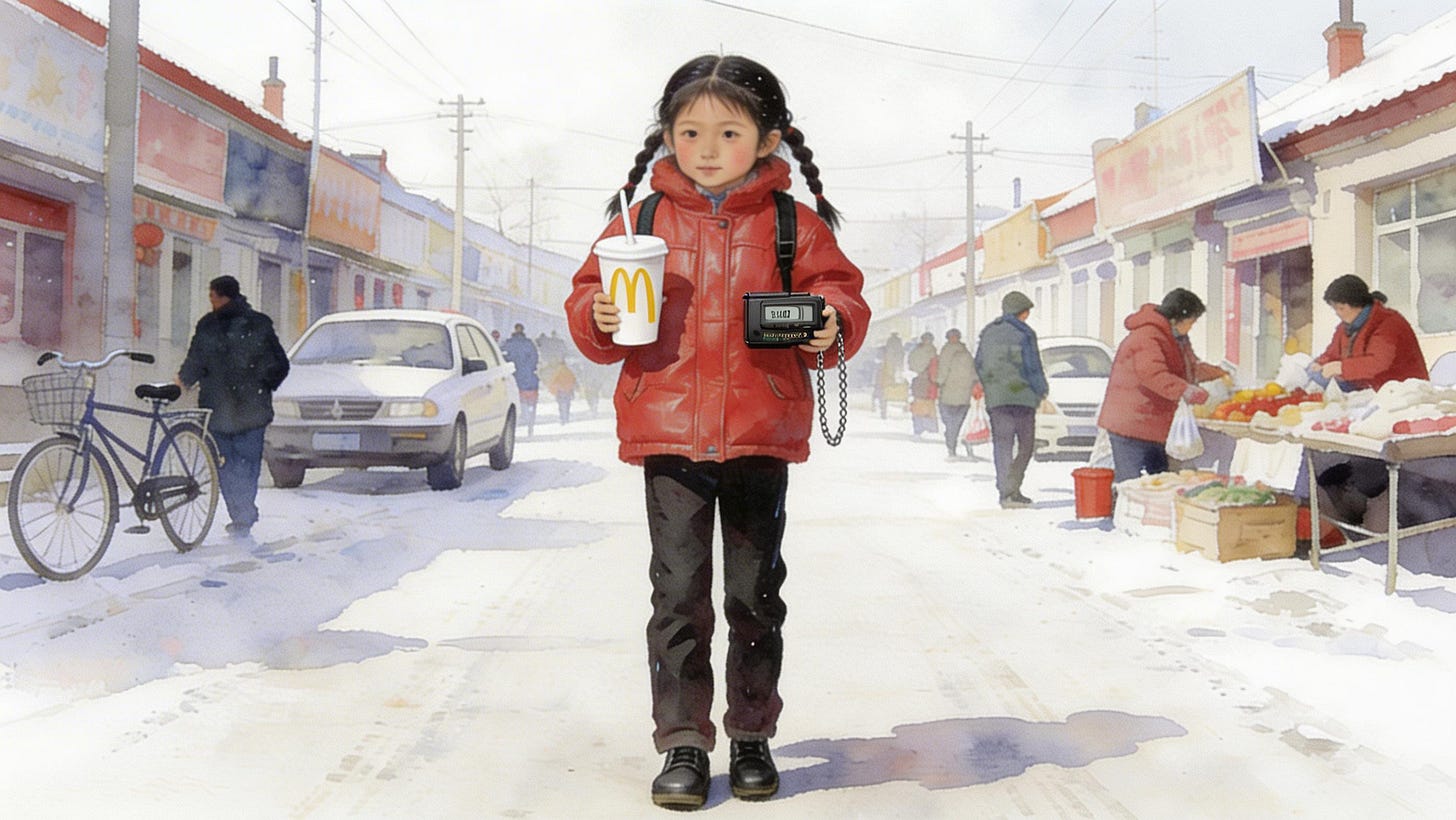
“Wow, I haven’t seen you in months! Where are you studying now? Did you get into the city middle school?” Lili asked. Two hornlike braids stood on her head; a fashionable new Mickey Mouse school bag hung from her back; in her right hand, she held a paper cup stamped with bright yellow “M” arches. Her clothes and leather shoes were stylish—clearly bought from real clothing stores—unlike his own, stitched from leftover scraps by his mother, loose and ill-fitting, making him look like a dirty rat skulking in a gutter.
“Yes, I’m in the city middle school now,” Little Mouse answered. “So is Fang Ling. We’re in the same class.”
“That’s wonderful. I’m so happy for you!” she said, already using words that didn’t exist in the local dialect—no one in this town would ever say, “I’m so happy for you.”
“Where are you now?” he asked.
“Stone Village. We moved. My dad got promoted to a position in the provincial government, so we all moved to the capital,” she said casually, as if it were nothing.
“Really? Then which middle school are you at now?” he asked.
“The River North Central Middle School.”
“Wow!” he exclaimed, astonished by the prestigious and out-of-reach name.
“Well, thanks to my dad. He got me a spot,” she answered lightly.
A surge of jealousy rose in his chest: he had to pass a brutal exam to enter a middle school in this small city, while she entered the best school in the entire province without breaking a sweat. If Lili had been mean, he might have felt justified in venting his jealousy and anger. But she was well-mannered, easygoing, and kind; her innocent eyes made him believe she was sincerely happy to see him, and that made him even more jealous.
“Did you come back by the long-haul bus?” Little Mouse asked.
“No, my dad was assigned a car from the bureau, along with a driver,” she said. “The driver was hungry, so I told him to grab some noodles. I’d rather walk to my grandma’s. Two hours in the car nearly broke my back.” She took a sip through the straw. “Damn, my McDonald’s is overflowing!” She licked the melting milkshake from the rim of the cup, then said with pride, “My dad bought it for me. McDonald’s just opened its first store in Stone Village. It’s so fancy and popular! You have to wait in line for half an hour just to get in. Have you ever heard of McDonald’s? From the United States.”
Of course he had heard of McDonald’s—from the television. In those days, American names and brands were everywhere: cars, sodas, fast food, satellites, sports, movie stars—who didn’t know McDonald’s? But hearing the dialect version of this global brand from her mouth was faintly amusing.
He couldn’t take his eyes off the cup, staring at the golden-arched “M.” It was the first time he had seen the legendary brand in the flesh. In this small town, food was usually packed straight into cheap, flimsy plastic bags. But McDonald’s came in a delicate paper cup, topped with a translucent white lid, its straw seeming to lead directly to a wellspring of happiness.
“Is it good?” His eyes were still fixed on the cup—something he believed he might never have in his life.
“It’s very, very good—vanilla, chocolate, and cream, sweet but milky too.” She smacked her lips. “No one makes milkshakes like McDonald’s.”
“How much is it?”
“Five yuan.”
Wow—a whole day’s budget for his family, spent on just one milkshake at McDonald’s. Little Mouse wished he could go to a McDonald’s and try hamburgers and French fries for himself: hot, sizzling beef patties sandwiched between bright green lettuce and slices of tomato, their juices mingling with the sauce—the mere thought was enough to make him salivate. And there would be glistening golden fries, fresh from the fryer, dusted with salt and smeared with thick red ketchup—what an unimaginable delight that would be. But there was no way for him to know. All he could possibly eat were napa cabbage, tofu, and steamed buns. Even pork was a luxury, which he could only eat freely during the Chinese New Year.
What was it that some great writer once said? “Human joys and sorrows are not shared.”
“Do people speak Standard Mandarin over there in Stone Village?” he asked curiously.
“Of course. Nobody speaks dialect there—dialects are so…backward,” she said dismissively, still speaking in dialect. Then she waved the beeper in her left hand in farewell. “I need to go visit my grandma. Let me know when you come to Stone Village. Give me a BP call!” The dialect had no word for “goodbye.”
“Absolutely!” He kicked his tricycle into motion.
But how? His mother would never give him even a penny for travel. The farthest he had ever journeyed to was the painted backdrops of a photo studio—pull the cord once and it was Beijing: Tiananmen Square; pull it again and it became New York: the Statue of Liberty and the Twin Towers.
Telephone? The only telephone he could access was the one in the corner shop outside the yard. If a call came in, the old shopkeeper would shout the name loudly at the gate for the person to come out and answer it. And he didn’t even have her number!
Starting to pedal again, Little Mouse felt a heaviness settle inside him. Beside her—as if reflected in a mirror—he saw himself as shabby, small-minded, and “trying too hard.”
One person’s floor might be another’s ceiling. This small place was all he had ever seen; yet, in truth, there was nothing to see: no parks, no mountains, no real nature. The city’s only river had long been polluted by the nearby fertilizer factory. The land along its banks was stained yellow-brown, crusted with white alkali. Both sides were stripped bare of vegetation, and the river itself flowed thick and dark, exhaling a pungent, acrid stench into the air. The lively festivities could only be found at the autumn temple fairs—when he was invariably confined to school.
Yet his mother was deeply satisfied, believing she had raised her sons into what she called a state of “low desire.” If you never bother to take your children out to see the world—then you block their vision, control the narrative, and emphasize how much they owe their parents simply for being born—they will never even conceive of asking for more.
End of Episode
Albert Aspen’s work is published simultaneously on this site and on his Substack page. If you prefer reading on Substack, please visit: Who is Albert Aspen?
Check out Albert Aspen’s Audiobooks on Spotify: Albert Aspen Audiobooks.