Ep 06: America, The Beautiful Country
As I Wish – Chapter Mouse (15 Min Read) Do you know: the Chinese name for the USA means "the Beautiful Country"?

The Very Beginning of an American Dream
Night had fully fallen. Under the hazy streetlights, most of the vendors had packed up, and the street gradually returned to quietness. Little Mouse sat on the edge of the tricycle, still turning over the Taoist’s words in his mind. The light had been too dim for him to see what the old man had written, and the brief five-minute reading left him more confused than reassured—filled with terms he could not understand at all. On this very night, the first domino of your destiny begins to fall. What begins to fall? He could think of nothing. He did, however, wish their homeroom teacher would fall ill so they might enjoy a few relaxed, unsupervised months. His thoughts were broken by the strained grunting of his father as the man pedaled the tricycle with effort. Approaching middle age, he had already begun to stoop.
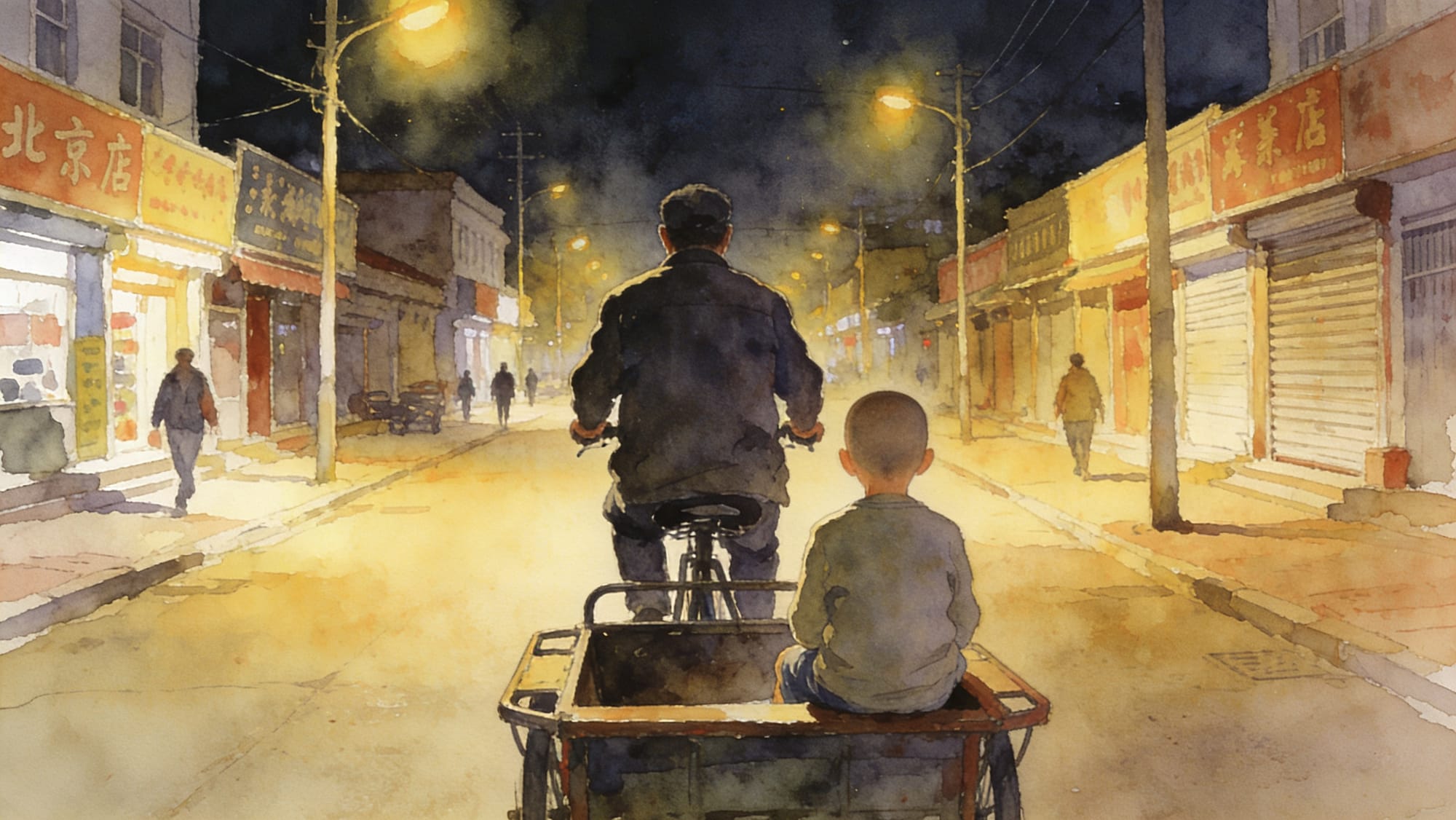
His father had not always been like this. When he was still working at the state-owned factory, he appeared humorous, cheerful, and talkative. Like every worker back then, he worked six days a week. Each morning, he would make his way into the factory compound with quiet confidence. Besides a stable salary, the factory distributed all kinds of goods as benefits—laundry detergent, pork, cooking oil, plastic sandals, enamel mugs, bed linens… Those supplies meant more than just material comfort; they signaled status, identity, and pride in the socialist system. Until one day—no, over the course of three long years—came the Great Layoff across the country. The state, which once promised a job for life, announced that there would be no jobs anymore. Millions of workers lost their livelihoods, and a deep despair settled over countless families.
His former colleagues, mostly middle-aged people in their forties and fifties, had already devoted the best years of their youth to that state-owned factory. After the devastating wave of layoffs, some scraped by on their savings; some sold off their possessions; some lived on loans; some ran small businesses on the street, like mending shoes or selling vegetables; some worked as safeguards or cleaners; and some drifted from one temp job to another; some… Fortunately, he taught himself acupuncture skills in his younger years, and it became how he made a living. Sure, he had quite a few patients every day, and he sometimes cured them like magic; yet he still felt a lingering shame about what he did. At the factory, he was the deputy head of the production unit. By all expectations, he could have advanced to unit head, department chief, or even deputy factory director. But the dramatic upheavals of the era broke those hopes. Now he was merely a street “acupuncturist” who had never attended medical school, surviving on a modest, small-time business.
Suddenly, one of the tricycle’s tires began to thump and jolt—it had gone completely flat. His father stopped the tricycle and said to Little Mouse, “Go on home first. I’ll pump some air into the tire.”
The walk home took no more than five minutes. As Little Mouse reached the yard, he saw an elderly beggar asking for alms by the fence gate. Noticing him, the beggar in ragged clothes turned and pleaded in a dialect he could barely recognize, “have pity on me—just a dime or two.” Little Mouse felt a stir of compassion. Just then, several neighbors walked out through the gate.
“Go on, get lost—try somewhere else!” one elderly neighbor scolded, waving him away. “There are beggars everywhere these days. Who knows if any of them are real?” Then, turning to Little Mouse, she added solemnly, “Make sure the gate is locked tight at night. Public security hasn’t been good lately—people keep breaking in to steal.” Another neighbor nodded repeatedly in agreement.
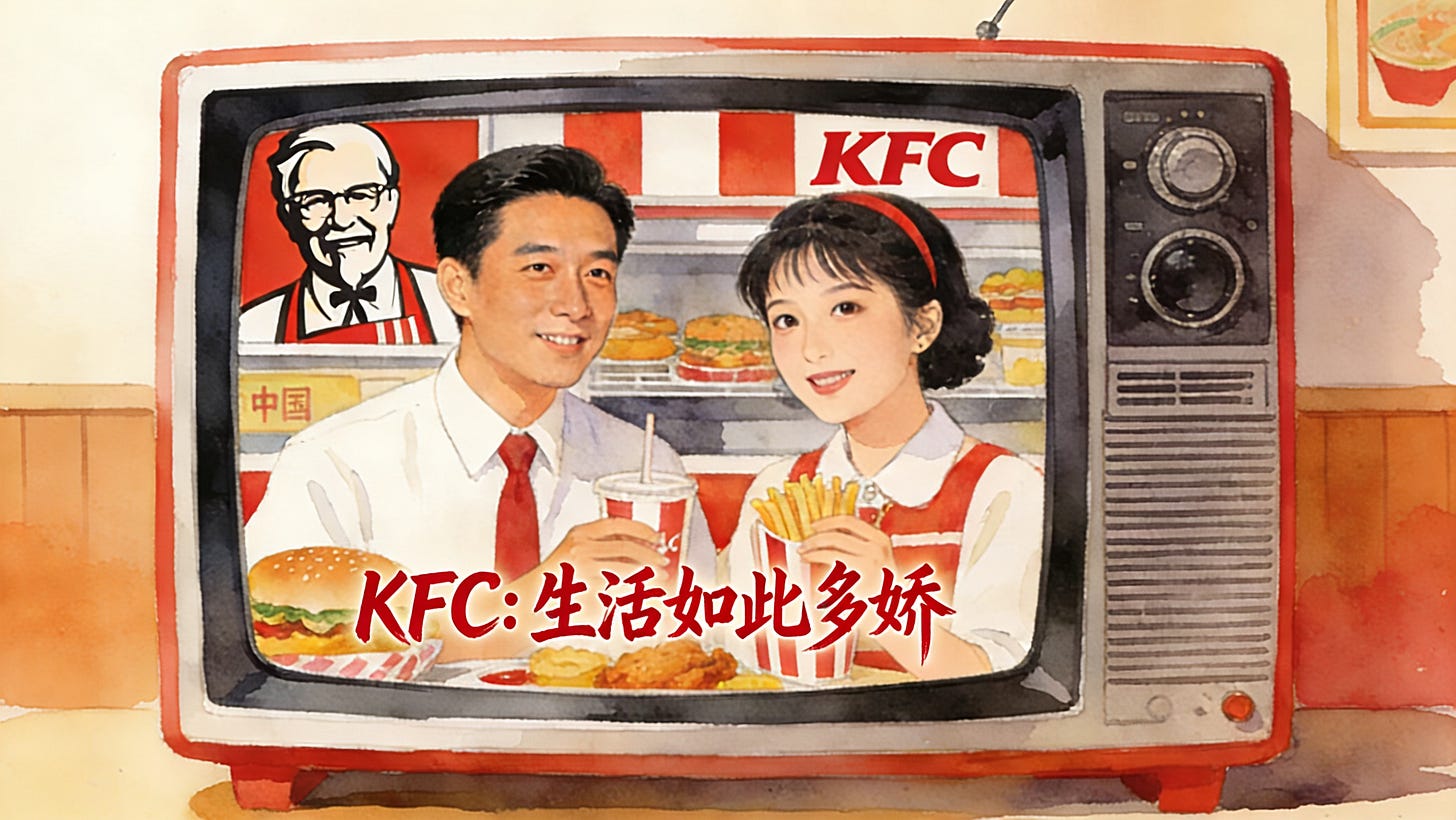
He stepped into the yard. Most of the neighbors had already returned. The same television commercials echoed through the yard from different homes—“KFC: Life is so wonderful.”
“Ignore that bastard Dong! Don’t move!” Suddenly, a woman’s hoarse yet piercing voice rang out, nearly startling him. “They wouldn’t dare do anything!”
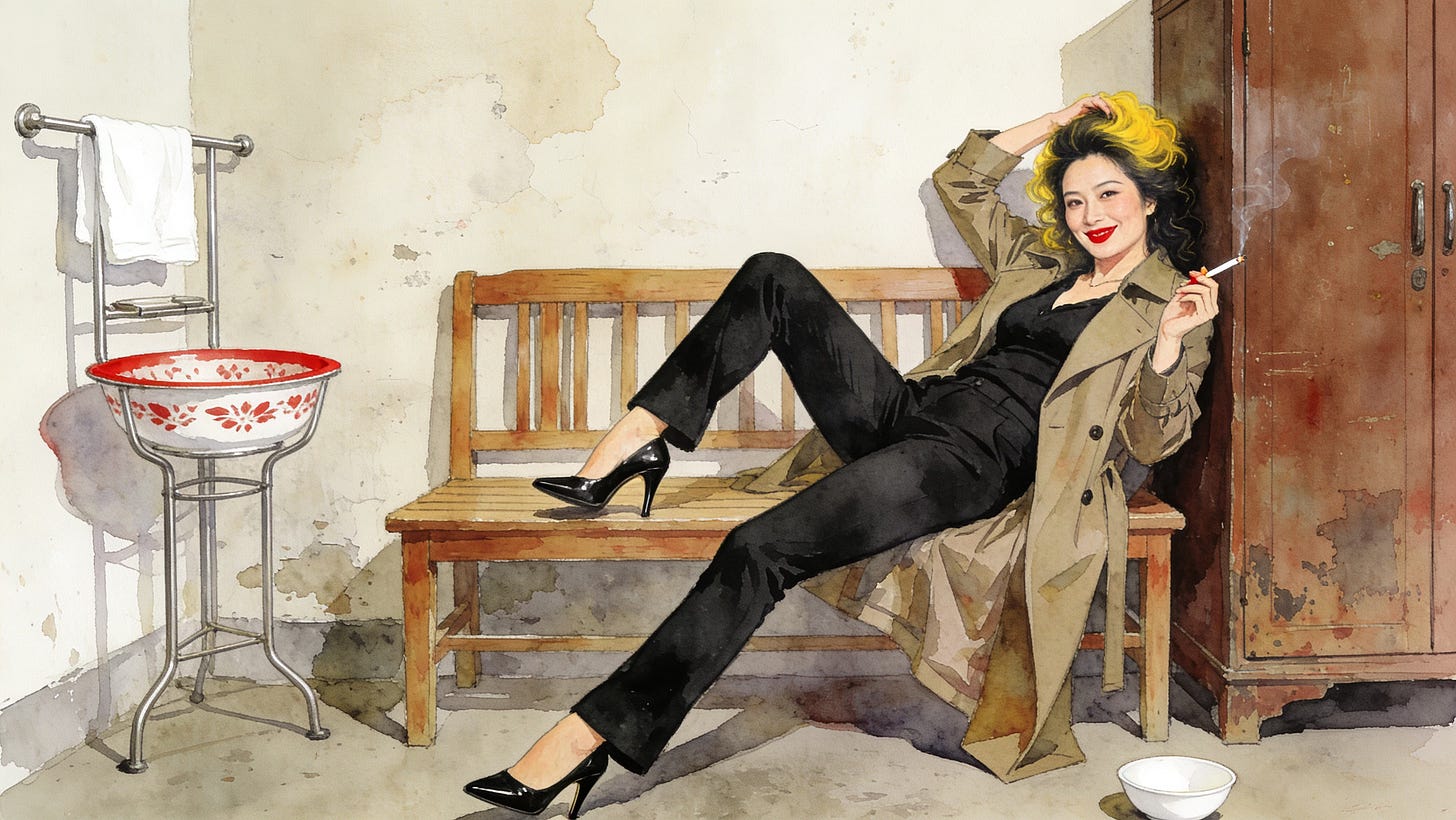
Little Mouse stepped into the unit he called home and was immediately choked by smoke, coughing as it filled his lungs. Through the haze, he saw a woman sitting on the wooden bench, blowing out a stream of cigarette smoke. She slouched back against the wardrobe. Her legs were spread wide: one high-heeled boot planted firmly on the floor, the other propped up beside her.
“Hi, Aunt Song!” Little Mouse greeted her quickly, before his mother could accuse him of being impolite.
“The college boy is back! How’s school?” Aunt Song took a hard drag on her cigarette, then leaned leftward and flicked the ash into the ashtray on the floor. Oh, it wasn’t an ashtray—it was a bowl the family normally ate from, with some water inside to put out the fire.
Her hair was piled high over her forehead, styled like the fashionable coiffure of a 1990s American TV anchor. Her face was thickly powdered, yet the roughness of her skin still faintly showed, and her lips blazed a vivid red.
“It’s… competitive. Much, much harder than elementary school,” Little Mouse replied as he washed his hands in the basin.
“If it’s competitive, then it’s competitive for everyone, isn’t it?” Aunt Song said, running her right hand through her yellow-dyed hair and sweeping it back. “Don’t let it scare you. You don’t have to be the best—just better than the people around you. That’s enough to win.”
“It’s only the beginning,” his mother replied as she heated the wok for stir-frying. “Starting next semester, his days will run from six in the morning until ten at night—morning drills, evening study sessions—and he might even be required to board at school, not allowed to leave campus for six days a week! These next few months may be the last time he gets to eat dinner at home.”
Hearing this, Little Mouse felt a surge of anxiety and despair welling up inside him. Soon enough, he would have to rise before dawn and grind on until late at night. Living in the school dormitory—just the thought of it felt like hell: dozens of teenage boys crammed into a narrow room, bunk beds packed tightly together, the air damp and foul, reeking of sour feet. The entire floor shared one small communal restroom, with only a few taps for washing. He could not fathom how anyone endured living in a place like that—more pigsty than dormitory.
“And River North is an extremely competitive place to take the College Entrance Exam. So many students competing for so few spots.” His mother poured a little oil into the wok and tilted it, swirling the oil across the surface.
Indeed, this province was nothing like those glittering points on the map—Beijing, the great capital, or Shanghai, the gateway to the world. River North was a mute yet massive province, with a population of nearly one hundred million. Every summer, nearly a million teenagers between the ages of seventeen and nineteen sat for the exam. But among the few dozen truly top-tier universities in China, each allocated only a few dozen places to this province. In the end, less than one percent stood any real chance of crossing the narrow bridge to success.
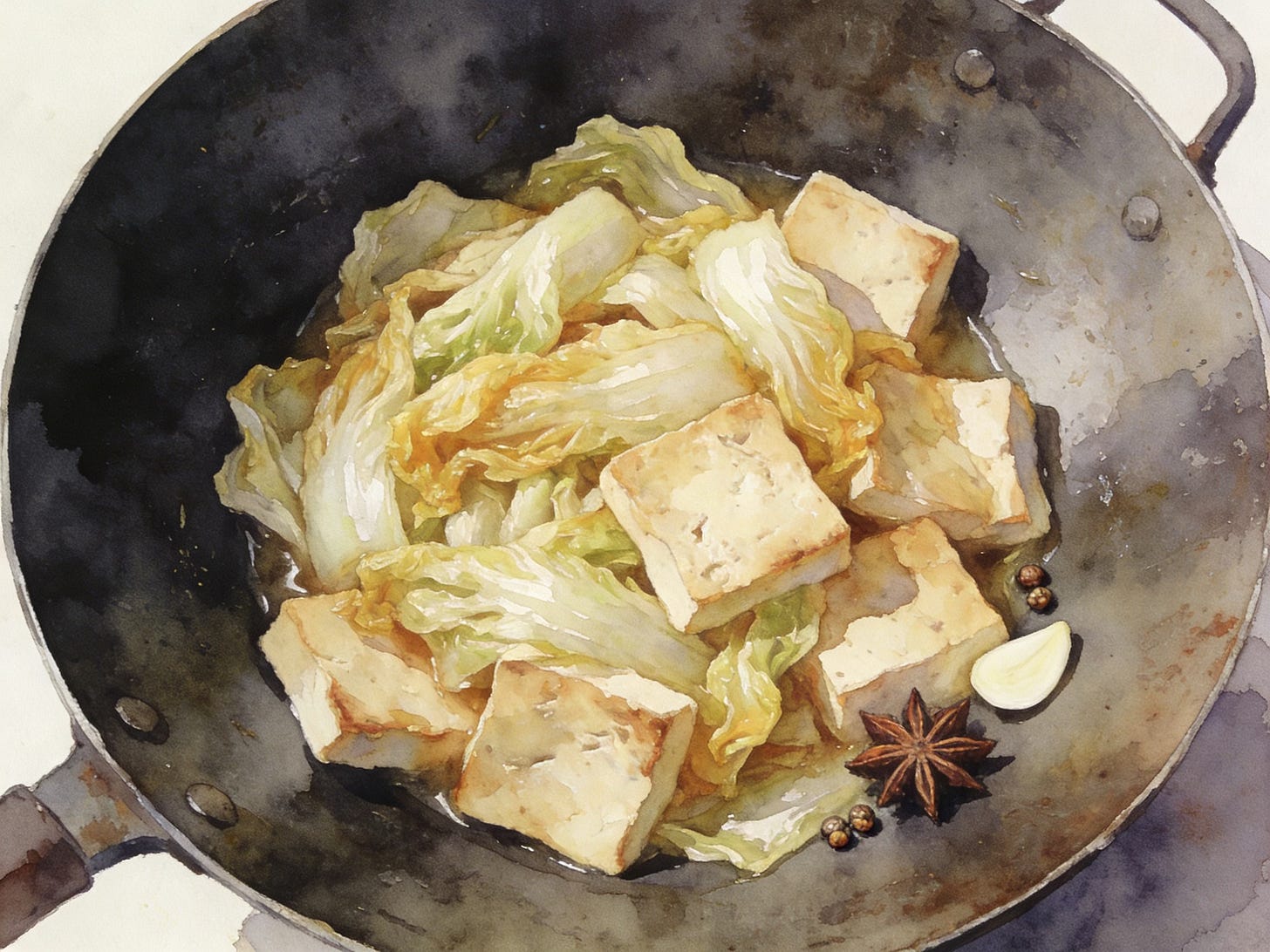
Sizzle—his mother tossed in the aromatics. Her cooking followed the same routine every day: oil first, then a quick handful of scallions, ginger, and garlic, followed by peppercorns and star anise. When the smoke thickened and curled toward the ceiling, she would throw in the cabbage, stir it a few times over high heat, then splash in soy sauce, vinegar, and salt almost at random before tipping the whole mixture onto a plate and serving it. She cooked everything this way—vegetables, pork, beef, even fish.
“Being born in a backwater like this was truly bad luck.” Aunt Song said, “But he is ‘college material.’ Becoming the first college student in the family is practically guaranteed. All your investments will pay off—you don’t have to worry.” She straightened her back as she spoke.
“You graduated from college with a diploma—so what?” his mother shot back. “The government doesn’t assign jobs anymore like it did in the 1980s. Graduates have to find work on their own now—who knows whether he will succeed then? If you finish college but still can’t find a job, you might as well not have gone at all. All that money and time wasted!” She launched once again into the same words she repeated every day at home.
His mother never missed a chance to remind Little Mouse that he should feel grateful simply for being able to go to school—an expensive undertaking, not to mention the costs of books and other necessities. As proof, she often pointed to her sister’s four children—Little Mouse’s cousins. Regardless of their academic ability, all of them were pulled out of school as soon as they completed the nine-year compulsory education and pushed straight into the family business: a construction crew. Before turning twenty, they were married off through family arrangements and soon began breeding like rabbits, with children arriving one after another to repeat the cycle, even though every child born outside the birth-planning quota meant another heavy government fine.
As cigarette smoke and cooking fumes gradually engulfed the room, the theme music of News Broadcast—the authoritative evening news program produced by China Central Television and carried simultaneously on all TV channels across the country—began right on time at seven o’clock sharp. At once, a bright, upbeat voice in flawless Standard Mandarin burst from the screen, filling the smoke-clouded room.
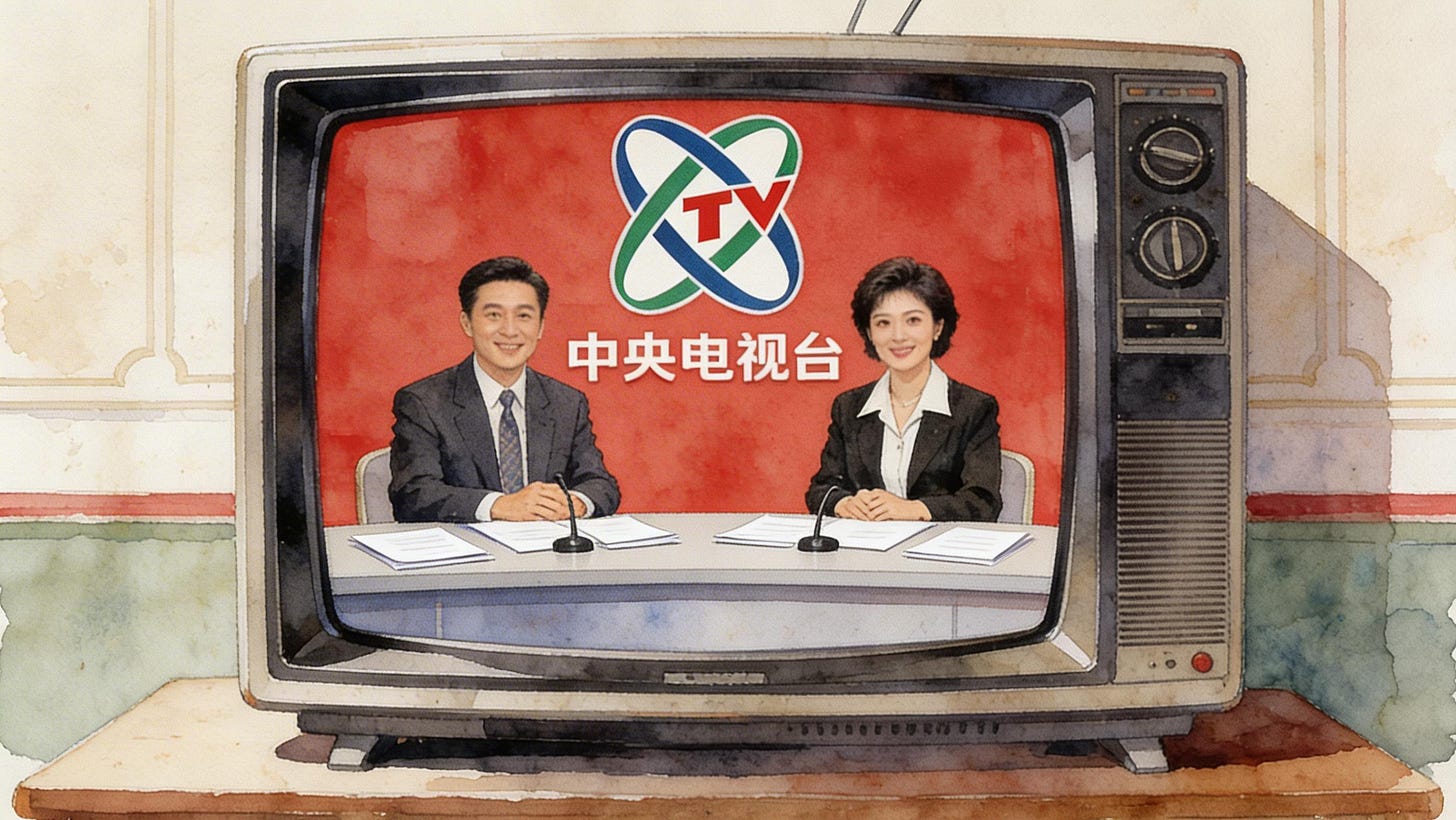
“Dear viewer-friends, good evening! Today’s broadcast will focus on the following: Under the strong leadership of the Party, economic reform has continued to yield remarkable results, with foreign investment reaching a record high. This year alone, China has received more than one billion dollars in investment from the United States. Representatives from China and the United States signed a memorandum in Beijing today to strengthen cooperation across multiple industries. At the invitation of the Chinese government, the President of the United States will pay a formal state visit to China next spring…”
“The United States, the United States, the United States. These days, everything is about the United States! As if no other countries even exist in this world. China has become the United States’ good student, learning from it everywhere you look—in every industry and in every policy.” Aunt Song had just stubbed out her cigarette when she immediately reached into her pocket and pulled out a fresh pack. “Do you remember our classmate, Shuli Wang?”
“Of course I remember—back in school, she buried her head in books every day, hardly ever speaking.” His mother stirred the cabbage in the wok as she spoke.
“Guess whom I met when I went to Beijing this time! She just came back from the United States after spending six years over there.” Elbows on her thighs, Aunt Song raised her cigarette and said, “River North University made her a full professor the moment she returned, just because she earned a PhD from an American university. She said one of her peers, who studied some advanced cutting-edge technology…something called… ‘international net,’ was offered the title of vice president right upon coming back to China.”
“Wow! What university did she get her PhD from?” Seeing someone who had succeeded through education, his mother’s interest was instantly piqued.
“She mentioned it! She said a school in New York…what was it…something about a cow…” (She meant SUNY Buffalo)
“A ‘cow university’?” his mother found the words awkward to pronounce in the local dialect. “Isn’t the ‘cow university’ in Britain?” (She meant Oxford University)
“That’s the British cow. This is the American cow!” Aunt Song lifted her hands into the air, speaking animatedly. “Right! Uncle Shan also went to America—he’s working as a chef in a New York restaurant! Every now and then, he sends money back to his mother. Just a few months of earnings over there would be enough to buy a house here in South Palace!”
“Wow...” His mother was too startled to comment. “How long has he been there?”
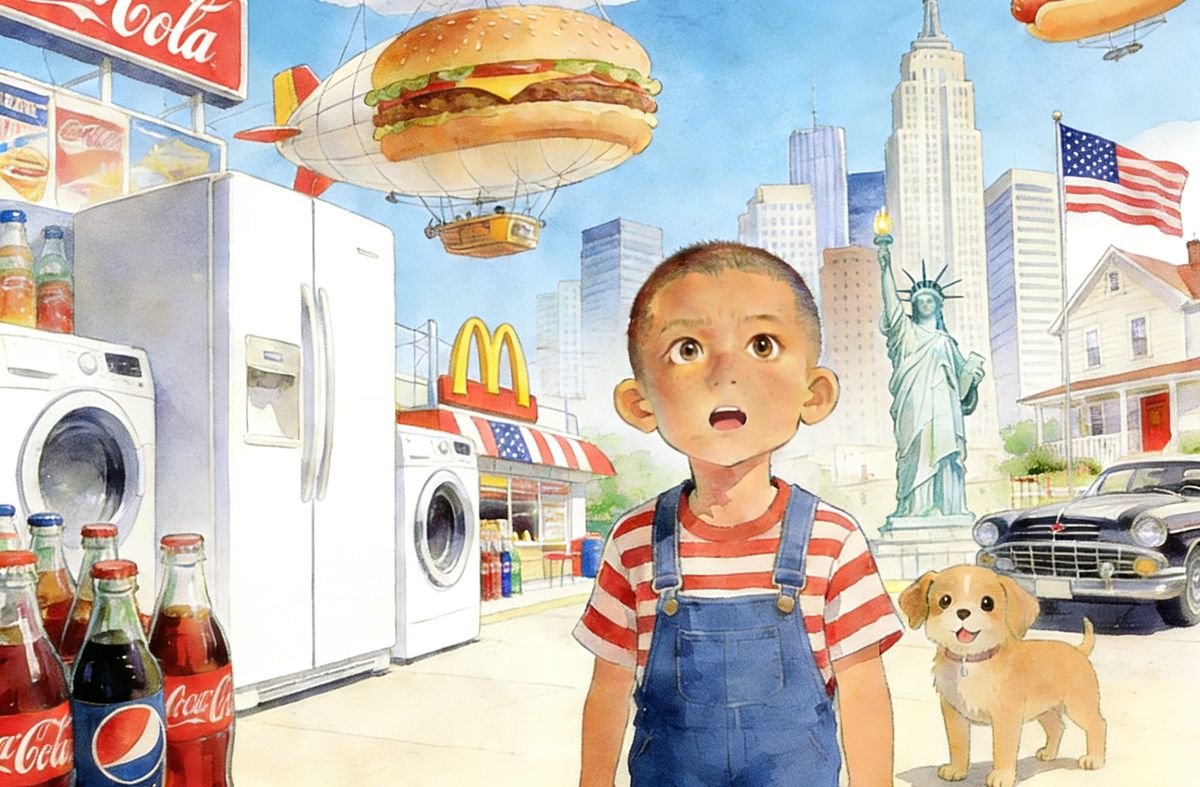
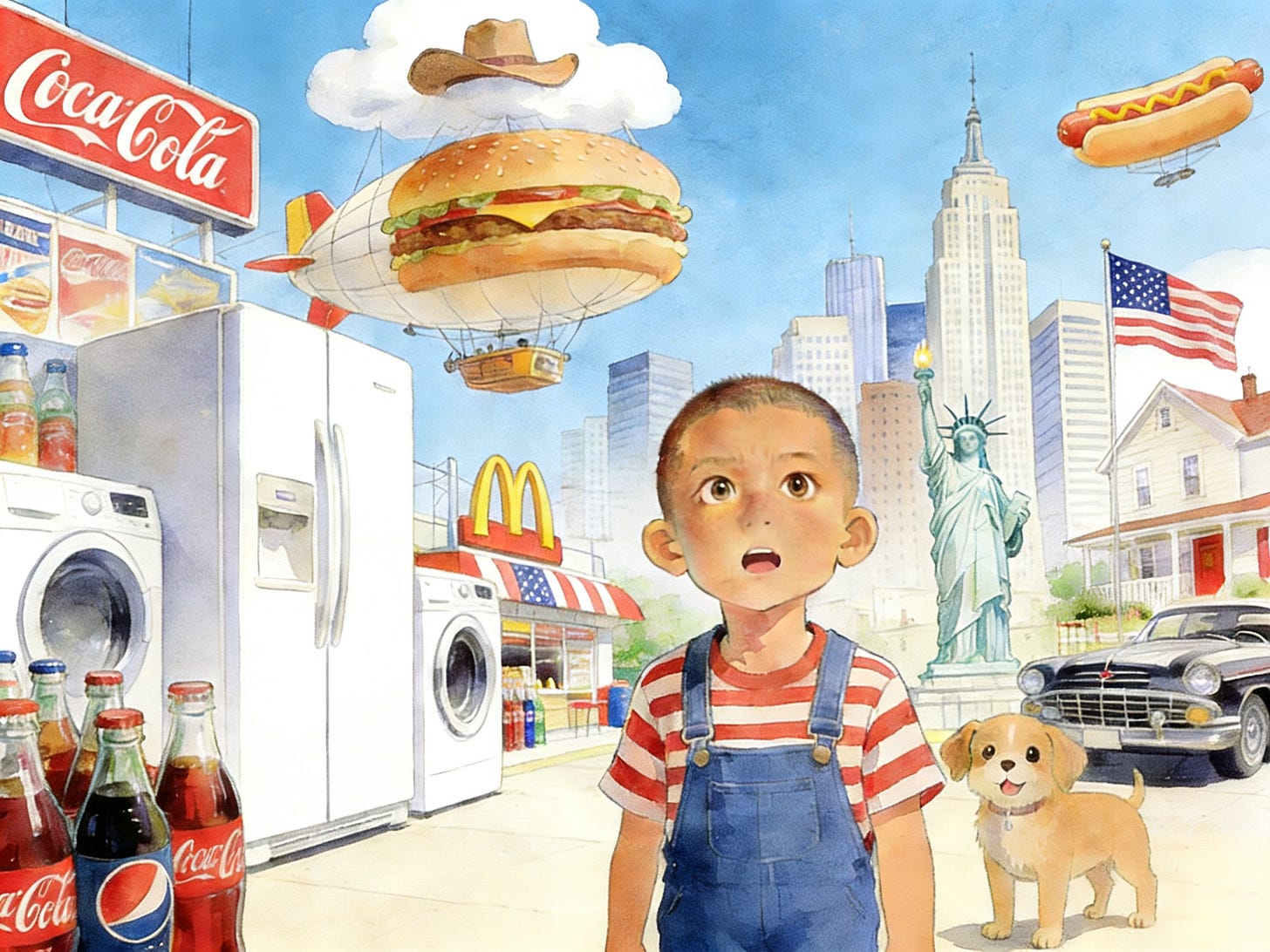
“I heard he’s been over there for several years now, almost long enough to get citizenship.” Aunt Song said. “The American people are so rich, so wealthy! One person’s salary can support an entire family. He said he didn’t even need to buy furniture—the Americans would throw away perfectly good pieces simply because they don’t like them anymore, leaving them out on the street for anyone to take. They don’t need to hang laundry on clotheslines because every household has a big dryer. Every family also has big refrigerators, big cars, and big houses. Children are so carefully protected and cared for. American schools always encourage students to be speak up their thoughts freely! In class, kids are free to prop their feet up on their desks and eat whenever they like. They can also speak without having to raise their hands first. In America, if you hit your own children, the neighbors will ‘butt in,’ and the police will come and arrest the parents. Even the dogs in America don’t bite because they’re treated so kindly!”
Sitting by the desk, Little Mouse heard, for the first time, such vivid descriptions of real life in the United States—not from TV, not from newspapers, not from his Politics textbook. He couldn’t stop fantasizing about paradise-like scenes—if you moved the furniture from the Growing Pains house into this tiny unit, it wouldn’t even fit! No wonder the Chinese name for the United States of America is “the Beautiful Country,” he thought.
“Wow…” His mother couldn’t say a word. A country like that was far beyond her life experience. She couldn’t even picture what a dryer looked like—over here, even a washing machine was still considered a luxury. “Those American schools always ‘encourage’ kids?” She finally found something to argue back with. “No, that’s just leading them astray. Kids need discipline to turn out right. We, the Chinese, always teach children to ‘stand with poise, sit with poise,’ ‘stand straight as a pine, sit solid as a bell.’ The American way of education is flawed!”
“I’d say you two should try your luck in the United States. You don’t have jobs anyway. What do you have to lose? Your sons could have a better life there if you went,” Aunt Song suggested.
“We can’t do that. How would we even get there?” his mother vetoed, placing the cooked napa cabbage on the round table. “We don’t have any money!”
“Uncle Shan says everyone fresh off the boat has no money! You can make money as long as you’re willing to work hard!” Aunt Song said.
“We don’t speak a word of English. Back in school, the foreign language we learned was Russian! Did you forget?” his mother said, ladling porridge into a bowl.
“Uncle Shan doesn’t speak English, either. He says that even without English, you can still get by in New York.” Aunt Song disagreed.
“That’s impossible! It’s just too far away. We can’t take that kind of risk. We still have a family to support.” His mother refuted, then turned to Little Mouse. “We’ll be counting on you. Study English well at school, go to New York someday, and earn big money for us!”
“American auto giants General Motors and Jeep have entered into a twenty-five-year agreement to establish joint-venture factories in Beijing, Shanghai, and Guangzhou. The two companies have pledged to invest more than one hundred million dollars as part of their global expansion strategy. With China serving as an ideal base for labor-intensive manufacturing, more than five million jobs are expected to be created over the next five to ten years, opening a new chapter of economic cooperation between China and the United States. The Party and the central government will coordinate with local authorities, parts suppliers, and financial institutions to promote continued prosperity in the Chinese economy…”
The good news in Standard Mandarin droned on. Meanwhile, Little Mouse’s father walked in after putting away the tricycle and immediately opened the window, coughing as he tried to let the smoke out.
“Wow, it looks like you’re doing well, Boss Hu!” Aunt Song greeted.
“How could I be doing well after losing my job?” his father kicked back while washing his hands.
“Oh, come on! I can tell you’re making more money now than you ever did at that factory!”
“No matter how much I make, it can’t compare with what those people pocketed after taking over the state-owned factory,” his father replied, his tone turning sour.
“Running your own business is good!” Aunt Song started her preaching. “The ‘stable’ factory salary was barely enough to survive anyway. Why do you think China started the Reform and Opening-Up? Socialism has failed. Capitalism—like in the United States—is the right way to go!”
“I would never get rich by putting needles into people.” His father said.
“The so-called ‘distribution according to work’ is already a thing of the past. It’s time to play a bigger game.” Aunt Song’s preach continued. “Do you know how much money my boyfriend made last year just by trading stocks?”
“That’s too risky! The stock markets were only established recently; you may lose it all overnight, too!” the mother immediately disagreed.
“You’ve got to be open-minded and see the opportunity. This is just the very beginning of China’s stock market, and that’s why it’s highly unlikely to lose…” Aunt Song’s tone was firm and optimistic.
Little Mouse stood up and walked outside—partly because he needed a breath of fresh air and partly because he needed to pee. The “restroom” was at the southwest corner across the yard, a three-minute walk away, and it was a dry latrine. No personal space, no privacy. Luckily, at that moment it was winter; cold was the only downside, and the smell was faint. Otherwise, like in summer, with those green-headed black flies buzzing around and large gray-brown geckos clinging to the walls…
When he was walking back, the old shopkeeper outside shouted loudly into the yard, “Song! Song! Hurry, come answer the phone! Someone’s calling for you!”
Aunt Song pulled the door open and stepped out. Suddenly she paused, fished a key out of her leather purse, and turned around to hand it to the mother. “Right, I almost forgot!”
“No worries. I will feed your cat on time every day!” his mother promised.
“Well, you guys have dinner! I will bring back gifts from the concert.” Declining the insincere invitation to stay, she walked into the yard. On the spot, she noticed Little Mouse in the darkness, veered a few steps toward him, looked him in the eyes, and patted his shoulder. The look in her eyes seemed like sympathy, or perhaps admiration, or even encouragement; yet she said nothing and then walked out.
End of Episode
Albert Aspen’s work is published simultaneously on this site and on his Substack page. If you prefer reading on Substack, please visit: Who is Albert Aspen?
Check out Albert Aspen’s Audiobooks on Spotify: Albert Aspen Audiobooks.