Ep 02: Forever Great, Glorious, and Correct
As I Wish – Chapter Mouse (12 Min Read) How education worked in China, and what they said about America.

Down, down, down—beneath the watchful gaze of the infinite, starry heavens—through layer upon layer of thick clouds, the boundless face of the Earth unfolded like a giant net. It was indeed a magnificent landscape: monumental highlands stretched from Siberia to the Indian Ocean, cresting in the Himalayas. Between the mountains and the sea lay a broad plain. The sweeping curve of the plain shimmered with the luster of jade, as if the land leaned to kiss the Pacific.
Descending further and further, vast swaths of farmland came into view, with fields divided by rows and rows of aspen trees. Straight dirt tracks extended outward and widened until they gradually dissolved into a web of human habitation—concrete streets, low-rise buildings, and flowing traffic coalescing into a small city. The city was laid out with the rigid precision of a Go board, its main roads running straight along the cardinal directions—north, south, east, and west. Square, orderly structures, both low and high, spread throughout the grid, each aligned along a north–south axis. Television antennas stood tall on the rooftops as if straining to catch signals from outer space.
A flock of doves glided between the silhouettes of the buildings, their pearly-white wings beating softly against the air. One long feather drifted down to the pavement, only to be lifted again by the gusts from passing cars and sent swirling through the streets.
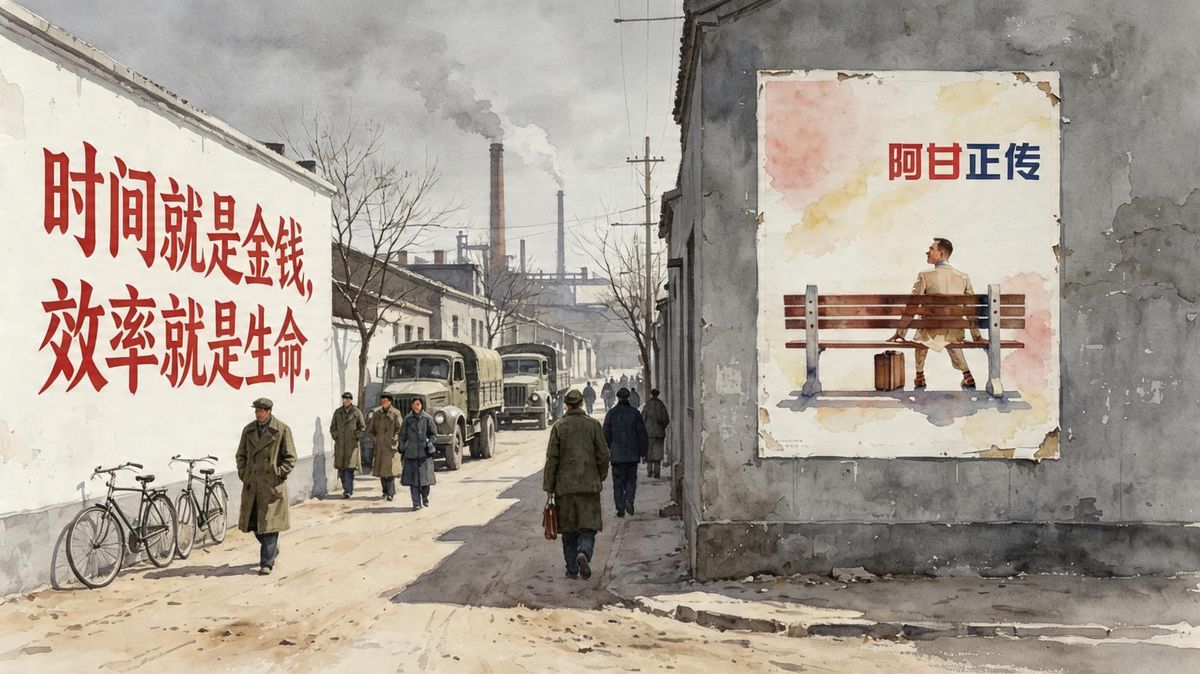
Against the rampart of a Soviet-era tower, a massive Forrest Gump poster fluttered along the wall, one corner torn loose by the wind. Across the street, an entire wall painted snow white bore twelve large, bloody-red Chinese characters:
Time is Money!
Efficiency is Life!
This slogan was unique to 1990s China, trumpeting the spirit of the era: it was a time of gold rushes, a time of miracles, a time so charged that, as long as you dared to dream, you could make anything happen.
Just a few steps away, another bright red banner hung high across the street:
Ending Humiliation of A Century through Prosperity!
Congrats on the Upcoming Return Home of Hong Kong and Macao!
Beneath the slogan, the signatory in small characters read: The Publicity Bureau of the Communist Party Committee in South Palace City, River North Province.
Oh, this must be the Great North Plain of the “Central Empire”—as China called itself. Slogans and banners had always been the means by which the ruler at the top, be it an emperor, a president, or a party secretary, propagated his “Forever Great, Glorious, and Correct” voice across the land, reaching even remote places like South Palace, a town so obscure that ninety-nine percent of the world had never heard of it.
It was already early winter, and the afternoon chill deepened. Two magpies flitted up and down in a tall persimmon tree, feasting on those lantern-like fruits hanging from bare twigs, their cheerful calls echoing through the quiet city. The streets were empty, with hardly any pedestrians. This place was so slow, stagnant, and languid that even Alexander the Great would grow drowsy upon arriving here.
Only one site in the city stood apart from the laid-back rhythm: at the northwestern edge rose a school of no great size. Unlike the town’s weathered red bricks and gray panels, the campus appeared much newer—the building was sheathed in glossy white tiles, and a vermilion gate arched like a crown. Directly above the grand entrance, enormous Chinese characters in gilt read “South Palace Middle School,” like a soul-sealing incantation. There, the steady cadence of reading voices could be heard from dawn to dusk as the “hopes” of this small city took root and took shape behind high walls.
The atmosphere inside the school was serious and tense. No playground, no library, no science lab. Only the holly bushes lining the grounds lent a hint of vitality. The main building at the center of the campus was divided into dozens of classrooms, like a cell block. Over eighty students were crammed into each classroom, measuring no more than six hundred square feet in size. A faint, sour smell of sweat hung in the air while the ceiling fans turned sluggishly overhead. Before each student, books and practice booklets were stacked nearly two feet high, forming interconnected rows like the Great Walls of paper. Some students behind those towering edifices looked sleep-deprived.
“Hurry up! We only have half an hour left. Let’s go over the key points in Politics for this month’s test.” A teacher entered the classroom closest to the entrance, speaking in the high-pitched local dialect of southern River North. English vocabulary scrawled in chalk covered the blackboard behind her. Above the blackboard hung a bright red banner:
As Long As You Haven’t Studied Yourself to Death, Study to Death!
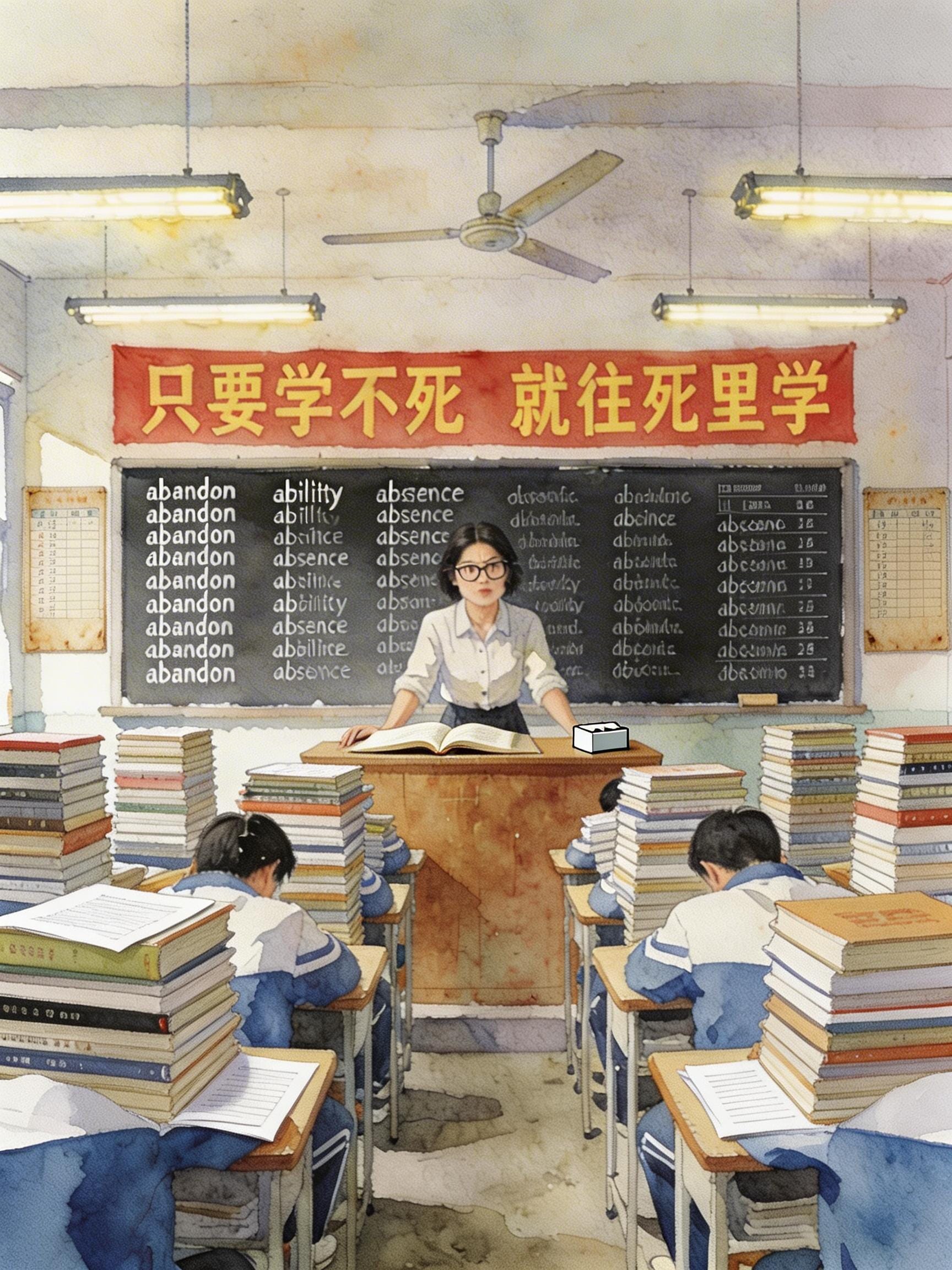
“This is the first year of middle school. Put your childish naivety behind you! It is time to confront the real world.” The teacher planted her hands firmly on either side of the lectern as she swept her gaze across the classroom.
In this place, the real world was nothing but endless exams. Exams were the method, the purpose, and the faith of education. For the next six years, at least, the students were forced to endure cycle after cycle of ruthless examinations and eliminations. Daily quizzes were skirmishes, monthly tests were campaigns, and annual finals were decisive wars. After each exam, all students’ scores and rankings would be posted on the classroom wall in a brutal display, as they were now, showcasing who had moved up a rung and who had been left behind. In six years, at least, it would culminate in “The Exam”—the three-day, once-a-year, “holy” National College Entrance Exam that would determine their fate.
“From now on, learn to allocate your time wisely to maximize your total score. Do not neglect a minor subject like Politics, as it could also prove fatal to your ranking. One point up, thousands of competitors down!” The teacher began flipping through the textbook. “Now, everyone turn to page four, pick up your pen, and underscore: ‘Our nation, the New China, is a country of socialism, a system fundamentally superior to and distinct from the decaying capitalist systems of countries such as the United States of America, which history will prove to be doomed.’”
While the teacher was reading from the textbook, she stepped down from the lectern and moved to the third row. Her eyes remained on the page as her left hand shot out and pulled a flashy Kung Fu novel from inside a textbook a boy was using as cover. Still reading, she kept her gaze on the textbook while her hand motioned toward the back of the classroom. The boy’s face burned with shame as he stood up, walked to the back, and remained standing for the rest of the class.
“Workers are the masters of our country! ‘Distribution according to work’ is the primary mode of distribution in China.” The teacher returned to the lectern and lifted her head from the textbook. She usually only adhered to the script, but this time she elaborated a little. “In our country, income is distributed according to work, but in capitalist countries such as the United States of America, honest, diligent workers earn far less than those who speculate in the stock market or manipulate political power—this reality fully exposes the rotten nature of capitalism”—she paused to look around—“and the stark hypocrisy of the American-style political system.”
“If there’s an exam question on the superiority of our system, make sure to select ‘Poverty Is Not Socialism’ as well.” Her high-pitched voice rose even higher. “Last time, only a handful of you chose correctly. Remember! It’s also a correct choice—BECAUSE THE STANDARD ANSWER SAYS SO! Don’t bother asking why.” Like a bald eagle spotting prey, she suddenly caught two girls whispering with their heads bowed. A stern glance shot from behind the teacher’s thick glasses. In a sharp flick of her wrist, she hurled a piece of chalk at them. The white bullet struck one of the girls on the head, and immediately, both of them snapped upright.
The classroom grew increasingly silent and oppressive. Fans and fluorescent lights squeaked overhead. Papers from the Great Walls occasionally fluttered in the breeze, as if stretching their legs. Most of the students kept their heads down, drawing lines in textbooks like robots, except for one outlier—a student who seemed truly intrigued by the knowledge.
The student, who looked years younger than his classmates, sat upright in the middle row, head lifted, meeting the teacher’s gaze as he searched for an answer. He squinted slightly as early-stage myopia made the blackboard appear hazy. Strikingly, above the tail of his right eyebrow lay a small crimson mole, resembling a red sun perched on a distant ridge. His hair was clipped short. Less noticeable, though no less significant, was a pointed bone jutting from the base of his skull—like a sharp sword straining to break free. In traditional Chinese physiognomy, it was known as the “rebellious bone,” a sign associated with defiance and betrayal.
“Next page, underline the fourth paragraph: ‘We make economic development the central focus. China’s fundamental policies include opening up to the outside world, one-child birth planning, and protecting the environment.’” The teacher tapped the desk. “These three will probably appear in the multiple-choice section—choose all three!” Spotting the only student upright, she asked, “Why aren’t you keeping your head down and marking the text like everyone else, Little Mouse?”
The classmates giggled as the teacher called the boy by his nickname instead of his real name. Only the girl a few seats to his right glanced over with concern.
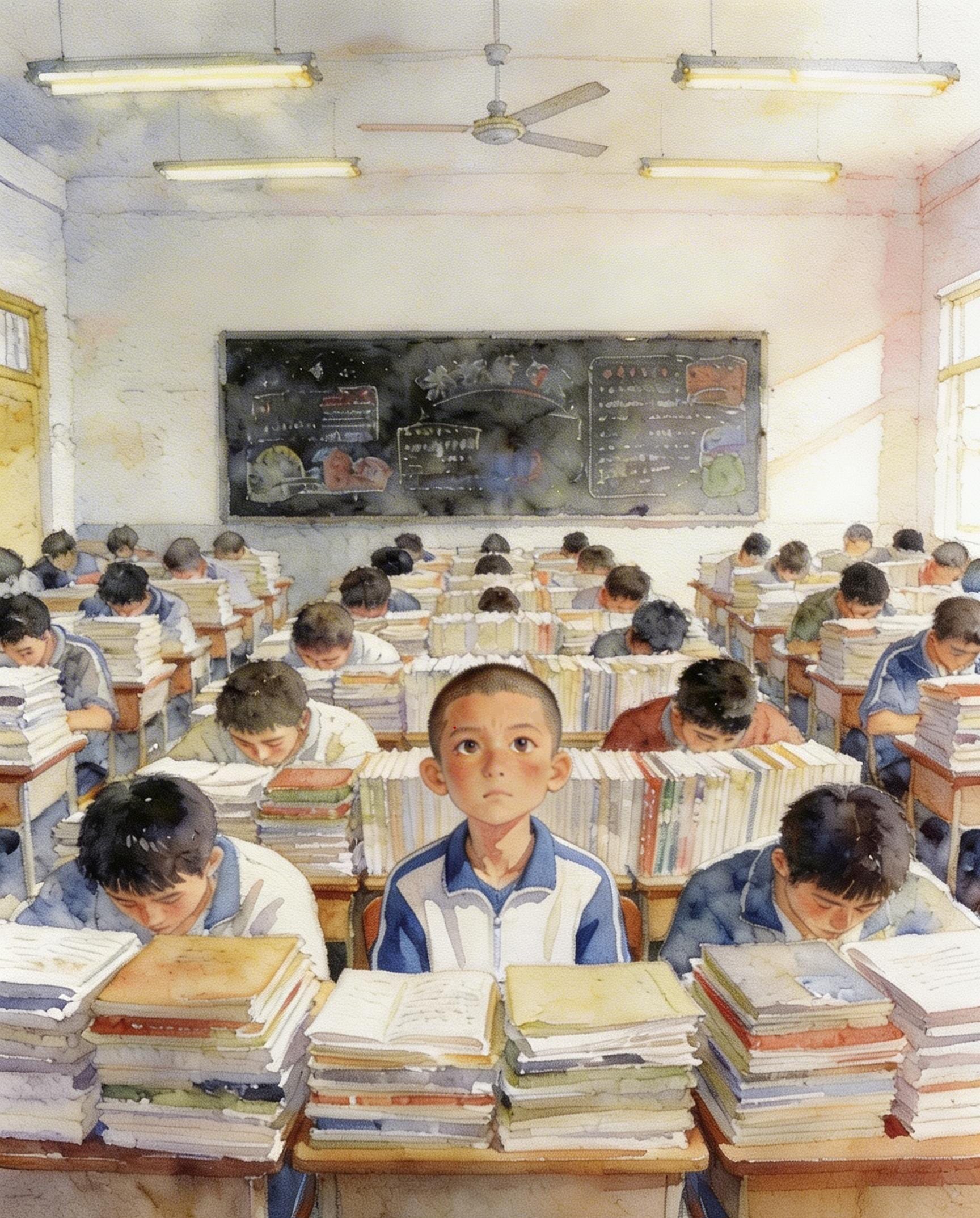
Little Mouse brushed off the nearby snickers by casting a withering glance and explained, “I am thinking—if the United States of America is truly so corrupt and so depraved, how has it become the strongest nation in the world? How, then, can it be called a ‘beacon of modern civilization’? I wanted to express my ideas better in case there’s an essay question…”
“YOU ARE NOT REQUIRED TO THINK OR ‘EXPRESS YOUR IDEAS!’” the teacher barked. “There will be no long essay questions for a minor subject like Politics. All you need to do is memorize the key points and write them down exactly as the textbook says.”
“But if I want to make sense…” Little Mouse insisted.
“You already scored perfectly on the last test. Put your effort elsewhere. Focus on subjects that will improve your overall score.” Her patience was wearing thin.
“I just want…” Little Mouse pressed on.
“We don’t have time for this! The rest of the class still needs this lesson—even if you don’t.” She pointed toward the back of the room. “If you’re too bored to do as I say, then go stand with that loser!”
Little Mouse stood up, composed yet unyielding, and walked to the back. Seeing this, the girl’s face hardened with stunned accusation.
“Next page, line seven,” the teacher continued, “Humiliation of the past century has taught us one truth: a weak nation has no diplomacy!” Her eyes remained fixed on the ten-year-old student, who bore the punishment with pride instead of shame.
“Next paragraph: ‘Our country’s primary economic system is the socialist market system. State-owned enterprises serve as the dominant force in China’s economy.’” She lifted her head, nudged her thick glasses up the bridge of her nose, and declared to the bowed heads, “Memorize it word for word—exactly as written!”
Suddenly, the five o’clock bell rang, but the teacher went on as though she hadn’t heard it. Only five minutes later, when the noise outside grew too loud for her to compete with, did she stop. The teacher walked out, textbooks and Kung Fu novel tucked under her arm. Little Mouse returned to his seat to pack up, and the girl to his right came over.
“That’s unfair!” the girl said in the local dialect. Neatly pressed uniform, twin braids of glossy black hair falling over her chest, and red glasses just a little too big for her face—she looked far more composed than her indignation suggested.
“It’s okay, Fang Ling. We’ve been sitting all day. I don’t mind standing for a while.” Little Mouse said, shoving his heavy practice books into his backpack.
“She shouldn’t have called you by your nickname. That’s very unprofessional for a teacher.” Fang Ling muttered in protest, as though standing up for him.
“Well, of all the nicknames I’ve ever had, this one is actually the nicest,” he replied.
“If your mother were willing to grease a few palms like everyone else does, you wouldn’t be treated like this,” Fang Ling said.
“Don’t you know my mom?” Little Mouse asked quietly, something unspoken beneath his words. “Anyway, it won’t be worse than elementary school.” The sunset blazed through the window, stinging his eyes. “I have to go. See you tomorrow.” He hoisted his backpack onto his shoulder and walked out alone.
The moment he stepped outside, he shuddered in the cold air, and with it came a muted embarrassment he refused to acknowledge: he had dressed too lightly. His oversized uniform hung loosely from his narrow frame, wrinkled and faintly soiled, like an elephant’s hide draped over a spindly bamboo pole. The cold wind turned his face red, and his nose began to run. He wiped it with his left sleeve, as he always did, then quickened his pace, hands thrust deep into his pockets—like a solitary eagle leaning into the wind. Movement was the only warmth he had.
End of Episode
Albert Aspen’s work is published simultaneously on this site and on his Substack page. If you prefer reading on Substack, please visit: Who is Albert Aspen?
Check out Albert Aspen’s Audiobooks on Spotify: Albert Aspen Audiobooks.