Ep 12: The Great Question That Haunts Us For Life
As I Wish – Chapter Bull (10 Min Read) What’s for lunch? In a city like New York, the question is never simple.

Disclaimer: This is a work of fiction. Any resemblance to reality is, of course, coincidental.
Stepping out of the office, Will felt a pulse thudding at the base of his skull. It was as if hundreds of rabbits had been loosed inside his chest, ricocheting in every direction, turning his thoughts into a frantic blur.
I shouldn’t have taken two. These psychiatric meds… they’re no better than drugs. They dull the symptoms, but never touch the root. There’s no exit plan in sight—you feel terrible without them, and once you start, the dosage only goes up—how is that any different from drugs?
Lost in thought, Will drifted into the elevator lobby just as a car arrived and its doors slid open. He stepped in, only to realize it was going up. Also inside were an Asian woman and a white man, both dressed in professional suits.
“Does it all have to be done today?” the woman asked, holding a work laptop in her left arm.
“That’s the order from the ‘people up there,’” the man replied.
“That’s a lot of work, with so many details to take care of,” she said.
“Well, it is what it is. It is what it is. Hush…” The man glanced around, noticing others in the elevator—no talking about business here. The elevator stopped at the eighteenth floor, and the two quickly stormed out.
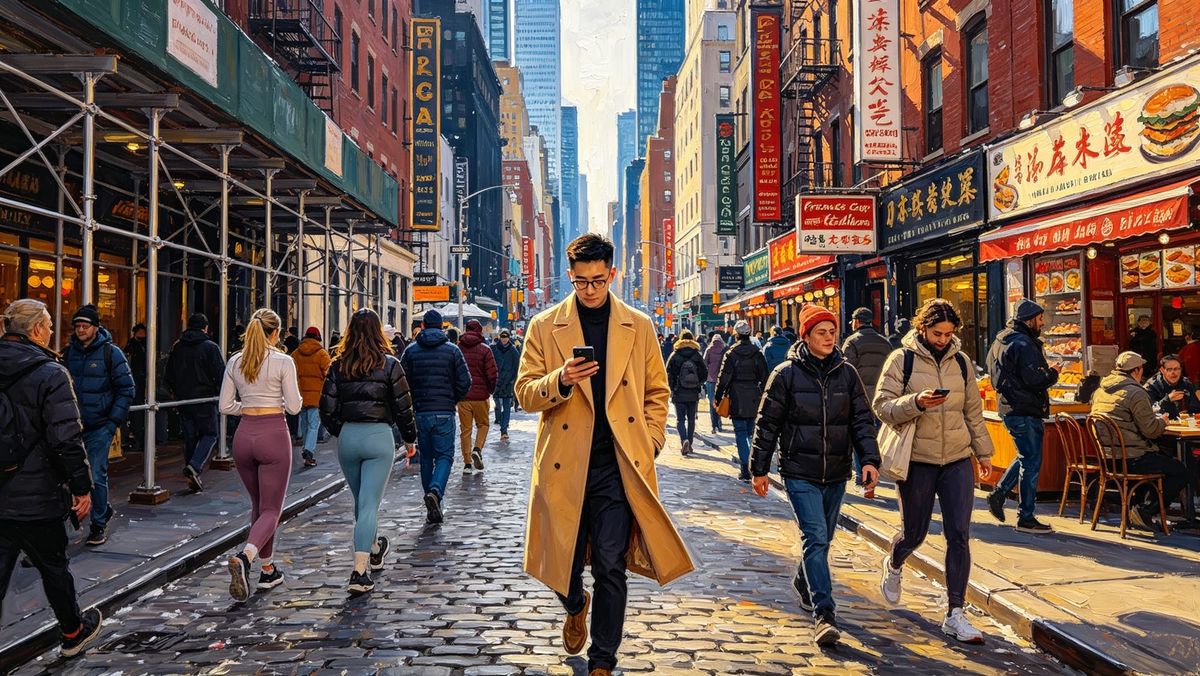
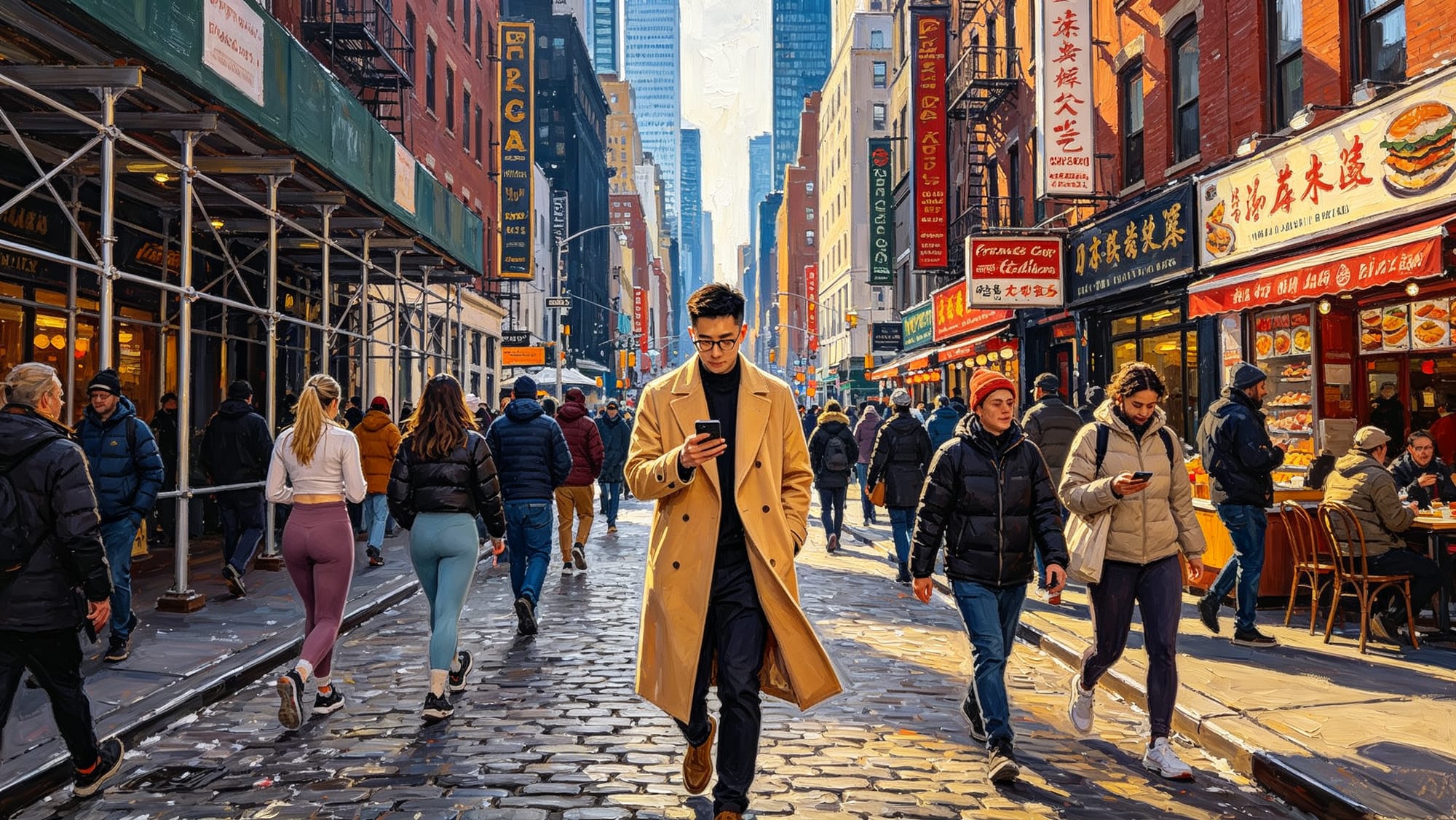
Out of the building, the sun shone overhead; a gust of cold wind swept in, and Will pulled his coat tighter around himself. Damn—January, the coldest month in New York. The stone-paved street of Wall Street was worn smooth by centuries of footsteps. Snow iced the uneven slabs, forcing him to tread carefully so he wouldn’t slip. Will pushed past crowd after crowd of tourists, deliverymen, and office workers, under scaffolding tunnels that stretched in every direction.
In winter, New York has nothing to do with fashion. Everyone was bundled into plump cocoons of heavy coats—except for the occasional pair of yoga pants. Trends repeat themselves like reincarnation: those yoga pants looked strikingly similar to the stirrup pants that swept across China in the 1990s. Women on the street seemed utterly unafraid of the bitter cold freezing their legs. Will couldn’t make sense of it. Why would they choose pants that clung so tightly in the dead of winter? Fashion magazines would never approve of such attire. But who cares? No one read those self-important magazines anymore. Over two decades into the twenty-first century, fashion magazines had become little more than glossy ad catalogs, far removed from the aesthetic authority they once claimed. Few people bothered to carry those heavy volumes home—they took up space, gathered dust, and would inevitably end up in landfills anyway.
Anyway—walking westward, Will kept scrolling on his phone. At that moment, he was preoccupied with the great question that haunts everyone for life: what to eat for lunch.
Head down, he flicked through the options.
That French restaurant on Maiden Lane cost too much, with four dollar signs ($$$$) next to its name. The absurdly small tables, paired with comically oversized plates, always put him off. Eating there felt like a disciplined detainee waiting for the waiter’s grand arrival—more a compliance test than fine dining. Moreover, given the portions, French cuisine was never suitable for a work lunch.
The food truck at the corner of Gold Street was serving the best American fried chicken in New York City. Golden chicken tenders dipped in premium ranch, crispy fries, juicy coleslaw, and a slice of toast—topped, for good measure, with a small paper American flag. He glanced over and saw a cluster of burly cops gathered out front, laughing among themselves, ignoring the repeated calls of “Order’s ready.” One might easily mistake them for a pack of street thugs if not for the uniforms. At this rate, it would be at least another half hour before his turn. He rolled his eyes and moved on.
There is a decent Italian pasta place over there, Will thought, but pasta is basically just noodles and sauce—too plain.
How about sushi? In this weather? Who eats something that cold and raw? I’m not some barbaric Westerner. He dismissed the idea immediately.
The Mexican diner on William Street was good—a balanced mix of meat and vegetables, with a wide variety of ingredients, and an ordering process that was simple and efficient, almost streamlined. Wait, didn’t I have Mexican yesterday? Better skip it today, then.
Chinese food, hmm. New York’s decent Chinese restaurants were mostly in Flushing or Midtown. As for those in Downtown—Shanghai, Sichuan, Cantonese, or Northern—they were an embarrassment to the dazzling breadth of Chinese cuisine, despite their glowing Google ratings. Restaurants like that wouldn’t last a few months if opened in China. But lucky for them, most Americans had never tasted the real deal. For many, the best they could imagine was General Tso’s chicken—a so-called Chinese dish that General Tso himself would never have recognized. This market of diners, shaped by a vaguely Puritan mindset, tended to be generous in its ratings. As a result, the more a place’s reviews came from non-Chinese customers, the less trustworthy its Google rating became.
Will kept scrolling on his phone. What else was there?
A McDonald’s sat a block away.
Ugh. Who would eat dirt-cheap junk food like that? He frowned in disgust.
Right, there is a pizzeria on Whitehall Street, the best in Downtown. It hit him all at once. Pizza was never a bad choice—maybe not the best, but never the wrong one. He slipped his phone into his pocket, turned left, and headed that way.
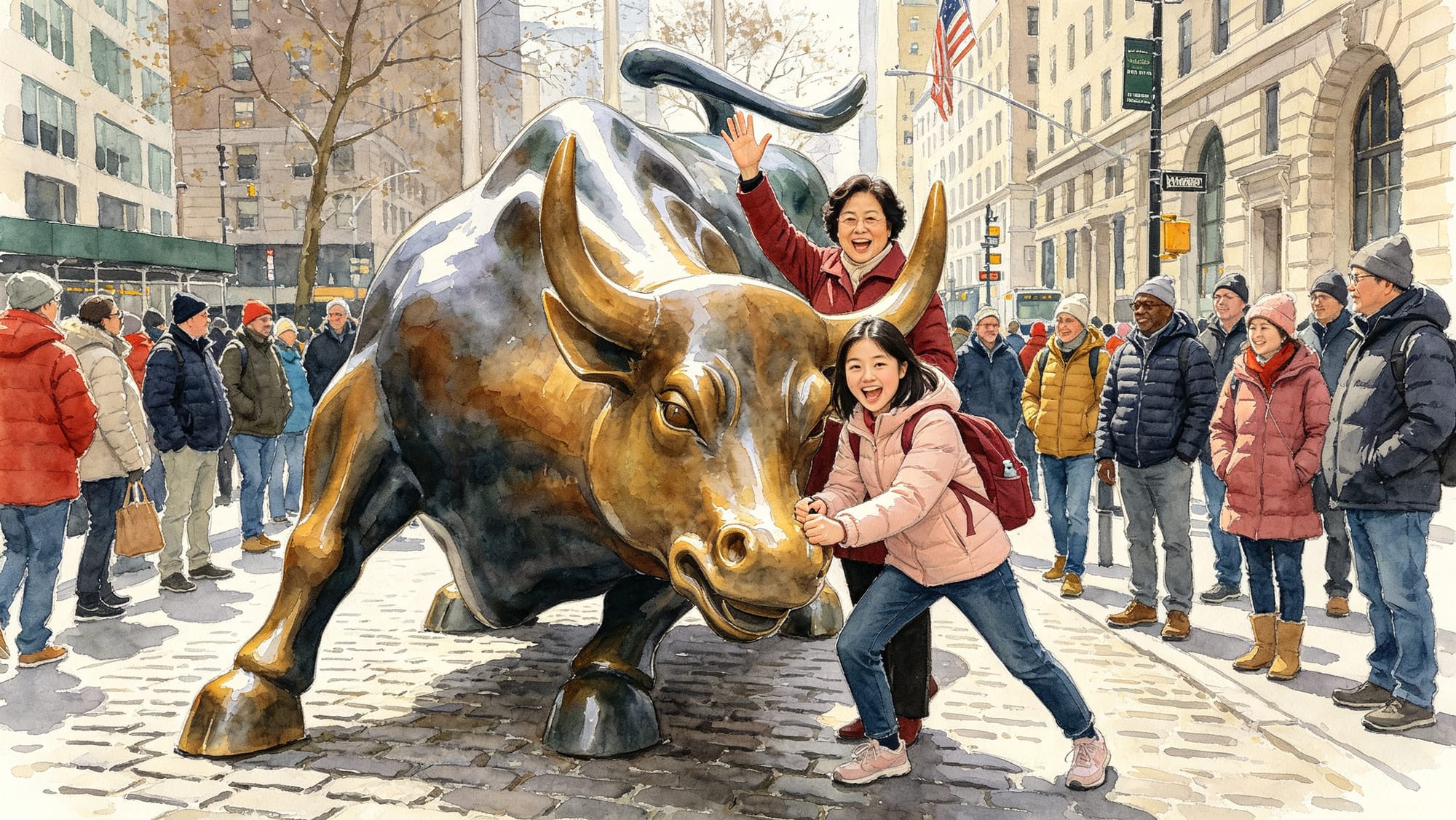
As he passed the Charging Bull, his mind wandering, two tourists—a middle-aged woman and her teenage daughter—suddenly stopped him.
“Could you help us take some photos?” the woman asked in standard Mandarin.
Wow! How rude! Will thought. What makes her assume that I am Chinese? I look so international! Yet he didn’t say any of it out loud, simply took the phone and framed them in the shot.
The mother-daughter duo maneuvered around the other tourists—first posing at the bull’s head, gripping its horns; then pressing their hands against its face; then circling behind it and striking a pose as if slapping its raised butt; and finally crouching down to clutch its testicles, smiling at the camera, flashing a V sign, and shouting, “Yeah!” The bull’s brownish body was uniformly dark and weathered, except for its testicles, worn shiny by countless tourists’ touches.
Poor bull, sexually harassed by strangers day after day. If it had a living soul, it would surely be in agony. Then again: because it was constantly groped by hands from all around the world, it would never end up coated in verdigris like the Statue of Liberty. In a sense, it was kept alive by human contact.
End of Episode
Albert Aspen’s work is published simultaneously on this site and on his Substack page. If you prefer reading on Substack, please visit: Who is Albert Aspen?
Check out Albert Aspen’s Audiobooks on Spotify: Albert Aspen Audiobooks.